Hook & Hastings
Opus 2407, 1918
All Saints Roman Catholic Church
Boston (Roxbury), MA, US
EXPLORE IMAGESSomething not quite correct?Suggest an Edit
🤝 Instrument entries in Massachusetts sponsored by:
We are grateful for the generous support of our sponsors, who make it possible for us to continue our mission of preserving and promoting the rich history of pipe organs across the globe.

IMAGES
Something missing or not quite correct?Add ImageorSuggest an Edit
STOPLISTS
No stoplist details are available. If you have stoplists, please consider sharing them with us.
Something missing?Add Stoplist
CONSOLES
Builder: Unknown
Position: Unknown
Design: Unknown
Pedalboard Type: Unknown
Features:
2 ManualsStop Layout: Unknown
Expression Type: Unknown
Combination Action: Unknown
Control System: Unknown or N/A
Something missing or not quite correct?Add ConsoleorSuggest an Edit
DETAILS
This instrument is: Not ExtantandNot Playable in this location
From Historic Boston Incorporated:
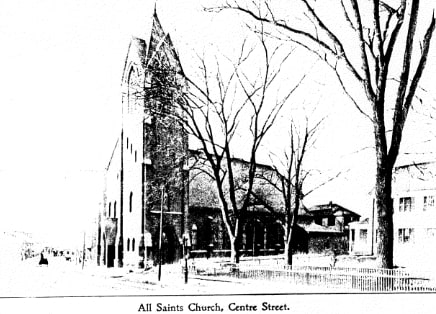
Unfortunately, clear images of All Saints are hard to find. Dedicated in 1897, it was designed by W.H. and J.A. McGinty of Boston, reportedly with much input from Father Smyth. It was Gothic Revival in style, and described as being built of “Roxbury stone” – presumably Puddingstone – with granite trim and a pressed brick superstructure. The church was entered through a corner tower finished with terra cotta moldings. The sanctuary was octagonal in form, and opened into a vestry. It was designed to accommodate between 800 and 1,000 people. The parish at its opening numbered about 3,000, its territory bounded by Highland Street, starting from Roxbury Street, and continued from Marcella Street to Seaver Street near Washington Street.
Also in 1897, the Archdiocese acquired the Dudley house for use as All Saints’ rectory. The two story house was significantly altered by the church, including the addition of a third floor with a hip roof and a semi-circular, columned entrance portico. The Dudley house continued as All Saints’ rectory until 1968, when it was taken by the Department of Public Works for the construction of a new highway. Because of the Dudley house’s historical significance, it was spared from demolition, but sadly All Saints church was not so fortunate. The church was demolished, along with many other houses and businesses, for the I-695 Highway that wasn’t built. What was once was a dense urban neighborhood is now a parking lot for Roxbury Community College. All that remains of the All Saints church is the house that served as its rectory for at least as long as it served as a home for the Dudley family.
Database Manager on February 28th, 2005:
Identified from company publications as edited and expanded in The Hook Opus List 1829-1935, ed. William T. Van Pelt (Organ Historical Society, 1991).
Something missing or not quite correct?Add NoteorAdd WebpageorAdd Cross ReferenceorSuggest an Edit