Charles Hendrickson
Opus 16, 1972
St. Olaf College
Christiansen Hall of Music
1500 St. Olaf Avenue
Northfield, MN, US
EXPLORE IMAGESVIEW STOPLISTSomething not quite correct?Suggest an Edit
IMAGES
Something missing or not quite correct?Add ImageorSuggest an Edit
STOPLISTS
Something missing or not quite correct?Add Stoplist
CONSOLES
Builder: Unknown
Position: Unknown
Design: Non-Traditional Style, As Consoles by Holtkamp, Schlicker, et al
Pedalboard Type: No Pedalboard
Features:
1 Manuals No Pedal3 StopsMechanical (Unknown) Key ActionMechanical Stop ActionStop Layout: Drawknobs in Horizontal Rows on Flat Jambs
Expression Type: No Enclosed Divisions
Combination Action: None
Control System: Unknown or N/A
Something missing or not quite correct?Add ConsoleorSuggest an Edit
DETAILS
This instrument is: ExtantandPlayable in this location
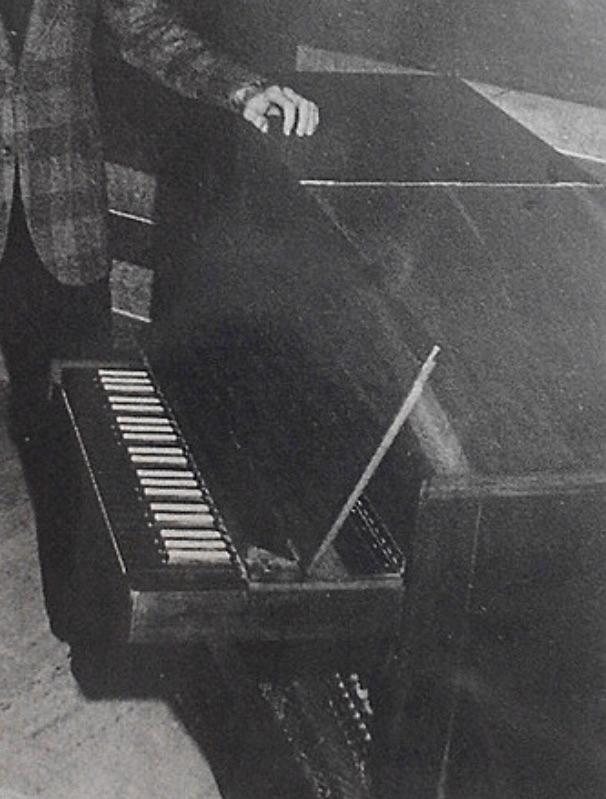
Charles Hendrickson and I designed this organ to go through the door of a Greyhound bus. He and I waited one evening in 1971/72 a the hotel in St. Peter until a bus arrived and we measured the door. The organ is fully portable and has been on a number of tours with the St. Olaf Choir, including to Europe. The mechanical key action is by woven wires and pulleys. Bass of the 8' Gedeckt is wood with metal treble. 4' is a chimney flute and 2' is a principal. Voicing by Robert Sperling. This was the first of several portativs built, one of which went to the Rockford Kantorei and another to UW Eau Claire. There are pull-out handles under the case for lifting, although they make it feel top-heavy and they are quite close together. The keyboard folds down inside the case, and doors on the front that can be removed. The case is thin walnut plywood. The lid opens up, and the blower is located in the void created by the treble pipes. On one occasion the organ was unloaded upside down and the pipes fell out. On another occasion someone who didn't know about the short octave moved the wires, making the bass keys play the wrong notes, much to Kenneth Jennings' consternation since it was only discovered during a concert.
Database Manager on May 28th, 2010:
Updated through on-line information from Andrew Schaeffer. -- Short octave in bass
Something missing or not quite correct?Add NoteorAdd WebpageorAdd Cross ReferenceorSuggest an Edit