Unknown Builder
1901
Originally E. & G. G. Hook (1869& c. 1830)
Congregational Church
617 NH Route 10
Orfordville, NH, US
13 Ranks - 645 Pipes
Something not quite correct?Suggest an Edit
IMAGES
Something missing or not quite correct?Add ImageorSuggest an Edit
STOPLISTS
| GREAT | ||
| 8' | Open Diapason* | |
| 8' | Salicional | |
| 8' | Dulciana* | |
| 8' | Clarabella | |
| 8' | Stop'd Diapason Bass | |
| 4' | Principal | |
| 4' | Flute* | |
| 2⅔' | Twelfth* | |
| 2' | Fifteenth* |
| SWELL | ||
| 8' | Keraulophon | |
| 8' | St., Diap. Tr. | |
| 8' | St. Diap. Bass | |
| 4' | Flute | |
| 8' | Cremona | |
| Tremolo |
| PEDAL | ||
| 16' | Sub Bass* |
| Couplers | ||
| Swell Couplet* | ||
| Great to Pedale | ||
| Swell to Pedale |
Something missing or not quite correct?Add StoplistorSuggest an Edit
CONSOLES
Builder: Unknown
Position: Unknown
Design: Unknown
Pedalboard Type: Unknown
Features:
2 Manuals 15 StopsMechanical (Unknown) Key ActionMechanical Stop ActionStop Layout: Unknown
Expression Type: Unknown
Combination Action: Unknown
Control System: Unknown or N/A
Something missing or not quite correct?Add ConsoleorSuggest an Edit
DETAILS
Exhibited in the 1972 OHS convention(s)
This instrument is: Extant and Playable in this location
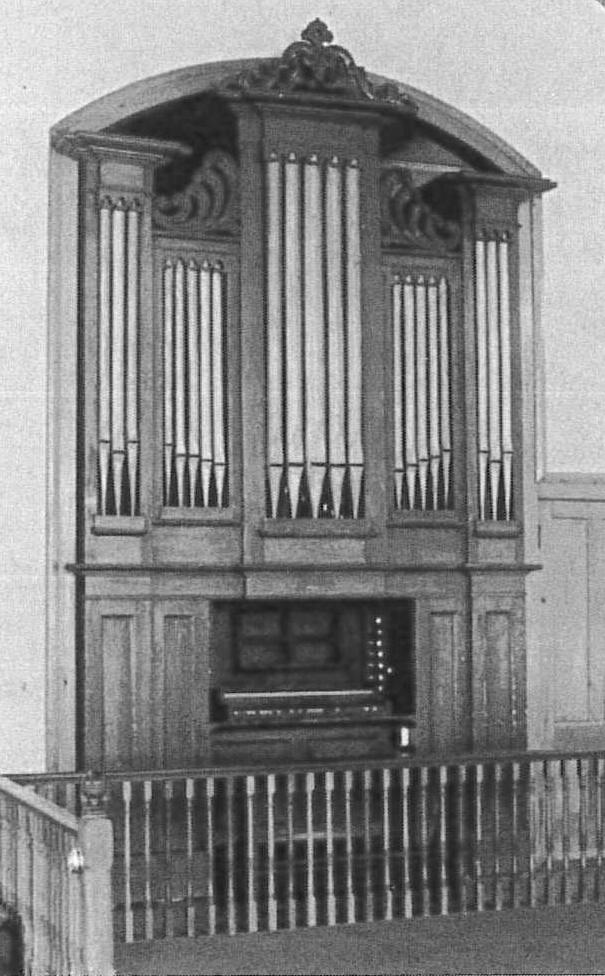
This organ is perhaps the work of a Massachusetts builder, and its first home is unlmown. The rearward extension of the case and the differing manual keyboards and action indicate that originally the organ was a nine-rank one-manual instrument with a small Pedal division. The present Swell St. Diap. Treble and Cremona were once on the present Great chest. The Tenor F SWell division was probably added not long after the organ was built, and in 1869, employees of E. & G. G. Hook moved the organ to the Congregational Church in Thompson, Conn., apparently installing the present Pedal division a.nd Swell bass. Two "string" stops may date from 1869, and most of the later stop labels are from the Hook factory. The organ came to Orfondville in 1901 at a cost of $351.70 and the only changes made in the past century are the addition of a Tremolo and an electric blower. The Cremona was temporarily removed in favor of another 8' "string" stop, and was recently rescued from the coal bin and carefully restored.
The pine case is fake-grained as oak and has paneled sides. The five flats of common metal speaking pipes comprise the Open Diapason from GG through F#0 (12 pipes) and the Principal from AAA# through FF# (9 pipes). The console is recessed behind sliding doors and is finished in mahogany and rosewood veneers. The Great keys are original. There is evidence of a metal name plate, and another pedal was at the left. The altered hitch-down Swell pedal operates horizontal shades on the small box above the Great. The Swell basses are unenclosed at the rear of the Great and the Pedal is on one chest at the rear of the organ.
The Open Diapason begins on GG; the Clarabella is of open wood pipes from F0 and is at the rear of the chest; the 3 lowest Principal pipes are of open wood; the Flute has stopped wood basses, is a metal chimney flute from C0, and has 12 open trebles; the St. Diap. Tr. is a metal chimney flute from C1; the Swell Flute is of wide-sea.le open metal pipes; the Cremona has 7 flue trebles. The 44-note stops commence on C0 and the 39-note stops begin on F0.
-- 1972 OHS Handbook
Database Manager on May 7th, 2018:
The first organ for the Thompson church of which we have any record was provided by E. & G. G. Hook, their second-hand No. 39, 1869. Originally built c. 1830. Who built it and where it came from we do not know; it served in Thompson until 1901, at which time it was moved, at a cost of $351.70, to the Congregational Church in Orfordville, New Hampshire. -- 1994 OHS Handbook
Database Manager on October 30th, 2004:
Status Note: There 1972
Database Manager on October 30th, 2004:
Original home unknown. Relocated, altered & enlarged by E. & G. G. Hook 1869 (#29 on list of 2nd hand installations) for Congregational Church, Thompson, CT. Relocated here in 1901.
Something missing or not quite correct?Add NoteorAdd WebpageorAdd Cross ReferenceorSuggest an Edit