Reuter Organ Co.
Opus 74, 1921
Residence: U. S. Epperson
Great Room Organ Loft
5200 Cherry Street
Kansas City, MO, US
21 Ranks - 1,539 Pipes - 3 Physical Divisions
Something not quite correct?Suggest an Edit
IMAGES
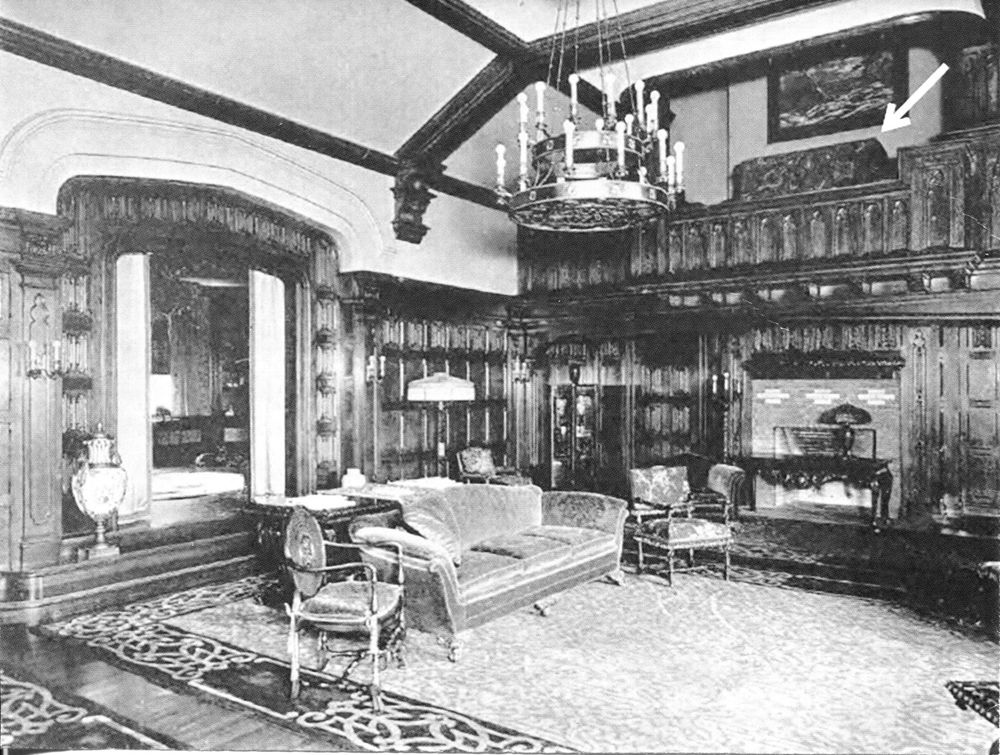
Something missing or not quite correct?Add ImageorSuggest an Edit
STOPLISTS
| GREAT (Expressive) | ||
| 16' | Violone | 73 |
| 8' | Diapason | 73 |
| 8' | Concert Flute | 73 |
| 8' | Dulciana | 73 |
| 8' | Violoncello | 12 |
| 8' | Viol Atheria | 73 |
| 4' | Traverse Flute | 12 |
| 8' | French Horn | 73 |
| Tremolo | ||
| Cathedral Chimes | EC |
| SWELL (Expressive) | ||
| 16' | Bourdon | 61 |
| 8' | Diapason | 73 |
| 8' | Gedackt | 12 |
| 8' | Viol d'Orchestre | 73 |
| 8' | Viole Celeste | 59 |
| 8' | Aeoline | 73 |
| 4' | Harmonic Flute | 73 |
| 4' | Violin | 12 |
| 2' | Piccolo | 24 |
| III | String Mixture | 98 |
| 8' | Oboe | 73 |
| 8' | Clarionet | 73 |
| Tremolo | ||
| Orchestral Harp (single stroke) | 49 | |
| Orchestral Harp (reiterating stroke) |
| ORCHESTRAL (Expressive) | ||
| 8' | Echo Salicional | 73 |
| 8' | Quintadena | 73 |
| 4' | Fern Flute | 73 |
| 8' | Vox Humana | 73 |
| Vibrato | ||
| Cathedral Chimes | 25 |
| PEDAL | ||
| 16' | Bourdon (X large) | 32 |
| 16' | Contra Violone | GT |
| 16' | Lieblich Gedeckt | SW |
| 8' | Cello | GT |
| 8' | Flute Dolce | SW |
Something missing or not quite correct?Add StoplistorSuggest an Edit
CONSOLES
Builder: Reuter Organ Co.
Position: Unknown
Design: Traditional With Roll Top
Pedalboard Type: Concave Radiating (Meeting AGO Standards)
Features:
2 Manuals (61 Notes)32 Note Pedal3 Divisions20 Stops29 RegistersElectrical Key ActionElectrical Stop ActionCoupler Toe Piston(s)Stop Layout: Stop Keys in Horseshoe Curves
Expression Type: Balanced Expression Shoes/Pedals (Details Unknown)
Combination Action: None
Control System: Unknown or N/A
Something missing or not quite correct?Add ConsoleorSuggest an Edit
DETAILS
This instrument is: Not Extant and Not Playable in this location
The Epperson House, located at 5200 Cherry Street in Kansas City, Missouri, was commissioned by Uriah Spray Epperson and his wife Mary Elizabeth Weaver Epperson. Uriah Epperson, born in 1861 in Indianapolis, moved to Kansas City at age six and became a prominent businessman, starting in the meat-packing industry before establishing the U.S. Epperson Underwriting Company and Epperson Land Investment Company.
The Eppersons hired French architect Horace LaPierre to design their mansion. According to local legend, LaPierre showed the couple plans for 1,500 different houses before they settled on the final Tudor-Gothic design. Construction began in 1919 and was completed in 1923 at a cost of $500,000 (equivalent to approximately $13 million in contemporary value).
The four-story mansion, encompassing approximately 24,000 square feet, contained 54 rooms and numerous notable features: A grand hall with a performance stage, a custom-built organ loft, a Grecian-tiled swimming pool, a billiards room, six bathrooms, elevators, a barber shop, a tunnel connecting the east and west wings, the "Elephant Room" for Mrs. Epperson's collection.
Uriah Epperson died in 1927, just four years after the house's completion. His wife Mary continued living in the home until her death in 1939, with over 600 people attending her funeral held in the house. In 1942, Lynn donated the house to what would become the University of Missouri-Kansas City.
Database Manager on July 3rd, 2013:
Updated through online information from Randal J. Loy. -- I tracked down the whereabouts through a request published in the national AGO magazine, July, 2013.
Reuter Organ Opus 74 was sold out of Epperson House. Mr. Epperson had died first (1927, and when Mrs. Epperson died in 1939, the house became the property of the man who was Mr. Epperson's business protégé and who had succeeded him as head of Epperson's insurance brokerage company. This man did not want the house; he was unmarried and did not need a 56-room mansion. He donated the house to the University of Kansas City, the campus of which adjoined the property on which Epperson had built the house.
In 1943, the University of Kansas City offered for sale the Reuter organ in Epperson House. Walmer Augustus "Gus" Brummer (1905-1995), at one time a representative for the largest district M. P. Moller Pipe Organ Company ever had, apparently purchased Reuter Opus No. 74 from the Epperson House, and during the difficult times of World War II, he dismantled the organ to sell it for parts.
He told one of his assistants that he "put the Epperson House organ in Niedringhaus Methodist Church" in Granite City, Illinois, but I have contacted Jack Jenkins, who is intimately acquainted with that instrument, which is a Kilgen organ, and he does not believe that any part of the Niedringhaus Methodist Church organ comes from Reuter Opus 74. He was involved in dismantling that organ and rebuilding it when the church building had to be rebuilt, and so he is in a position to know the individual parts of that organ. He feels very strongly that Mr. Brummer, whom he also knew very well by association, unquestionably would have purchased the Epperson House organ merely to use for parts.
Database Manager on November 24th, 2005:
Identified from the Reuter Opus List, provided by Chris Leaver, Reuter Organ Co., November, 2005.
Something missing or not quite correct?Add NoteorAdd WebpageorAdd Cross ReferenceorSuggest an Edit