William J. Davis
1881
West Bloomfield Congregational United Church of Christ (1875)
9035 Route 5
West Bloomfield, NY, US
16 Ranks - 857 Pipes
EXPLORE IMAGESVIEW STOPLISTSomething not quite correct?Suggest an Edit
IMAGES
Something missing or not quite correct?Add ImageorSuggest an Edit
STOPLISTS
| Great (I) | ||
| 8' | Open Diapason | 58 |
| 8' | Melodia | 58 |
| 8' | Dulciana | 58 |
| 4' | Octave | 58 |
| 4' | Flute d'Amour | 58 |
| 2 2⁄3' | Twelfth | 58 |
| 2' | Principal | 58 |
| 8' | Swell to Great |
| Swell (II - Expressive) | ||
| 8' | Geigen Principal | 58 |
| 8' | Stopped Diapason | 58 |
| 8' | Viola | 58 |
| 4' | Harmonic Flute | 58 |
| 4' | Violina | 58 |
| 2' | Piccolo | 58 |
| 8' | Oboe | 49 |
| Tremulant |
| Pedal | ||
| 16' | Bourdon | 27 |
| 16' | Lieblich Gedeckt | 27 |
| 8' | Great to Pedal | |
| 8' | Swell to Pedal |
Replacement stop labels by Delaware Organ Co.
Pedal Check; Bellows Signal; Compass: Manuals: 58 notes, all stops go through except Oboe.
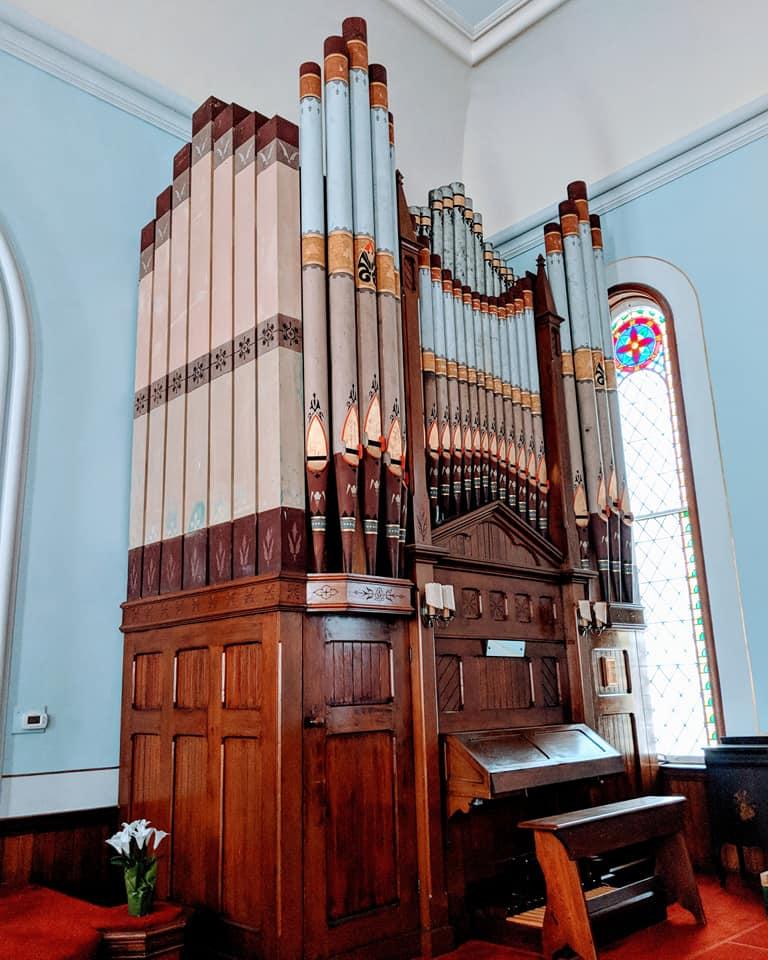
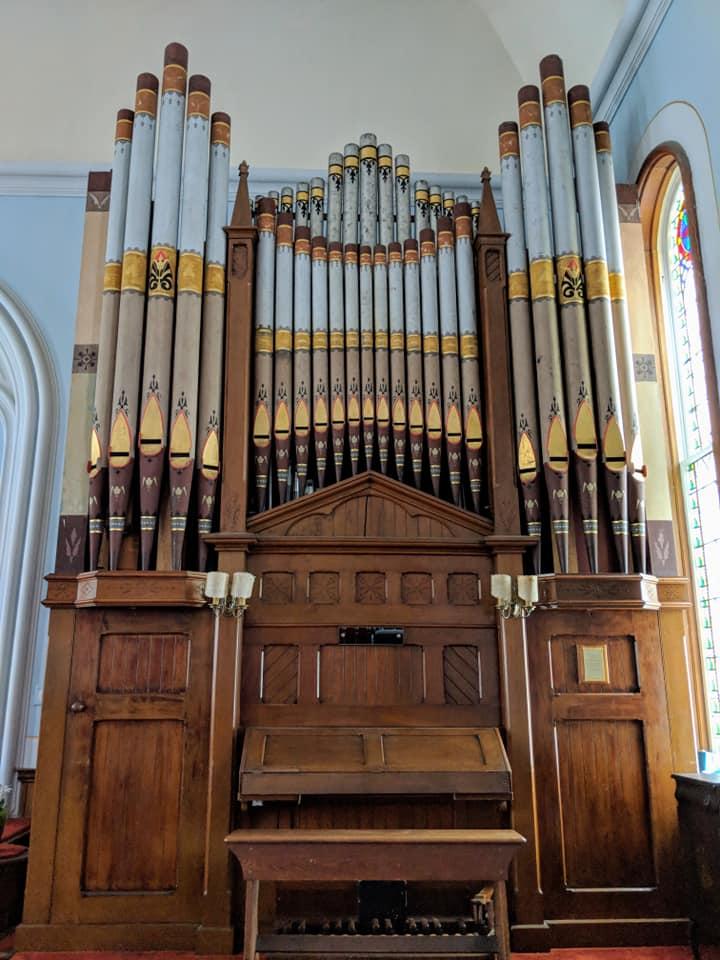
Projecting keydesk, Swell stacked over Great, round shanks, balanced swell pedal.
[Originally received from Scot Huntington 2013-05-07.]
Originally Written/Published: June 2018
Something missing or not quite correct?Add StoplistorSuggest an Edit
CONSOLES
Builder: William J. Davis
Position: Keydesk Attached
Design: Traditional With a Keyboard Cover That Can Be Lifted To Form a Music Rack
Pedalboard Type: Flat Straight
Features:
2 Manuals (58 Notes)27 Note Pedal3 Divisions16 Stops22 RegistersMechanical (Unknown) Key ActionMechanical Stop ActionStop Layout: Drawknobs in Horizontal Rows on Terraced/Stepped Jambs
Expression Type: Balanced Expression Shoes/Pedals (Not Meeting AGO Standards)
Combination Action: None
Control System: Unknown or N/A
Something missing or not quite correct?Add ConsoleorSuggest an Edit
DETAILS
Exhibited in the 2018 OHS convention(s)
This instrument is: ExtantandPlayable in this location
from the 2018 OHS Handbook:
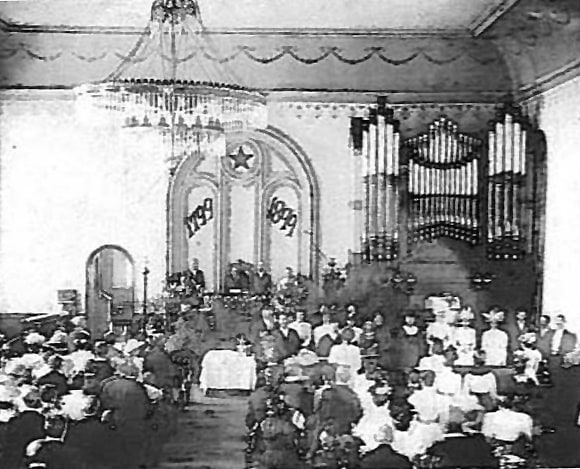
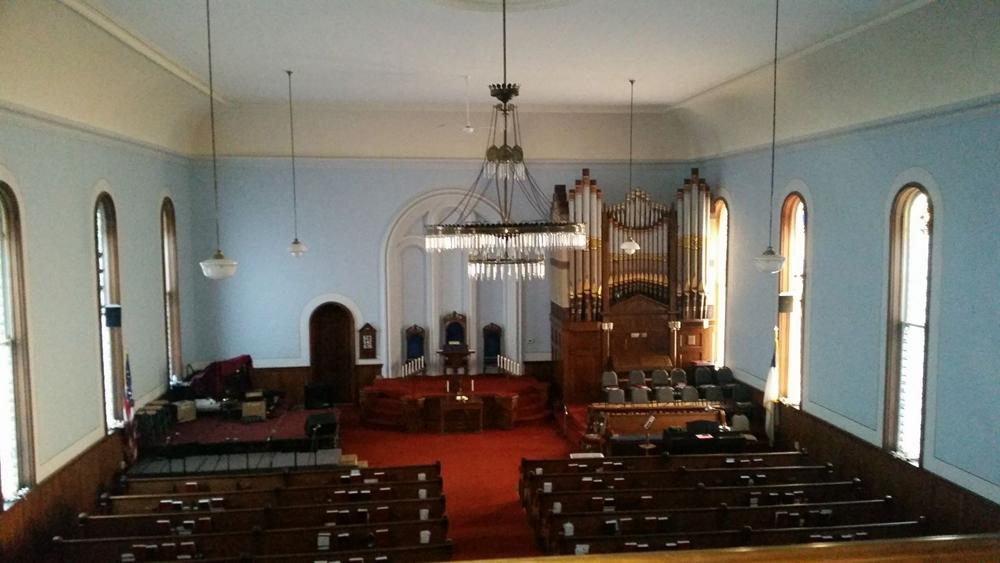
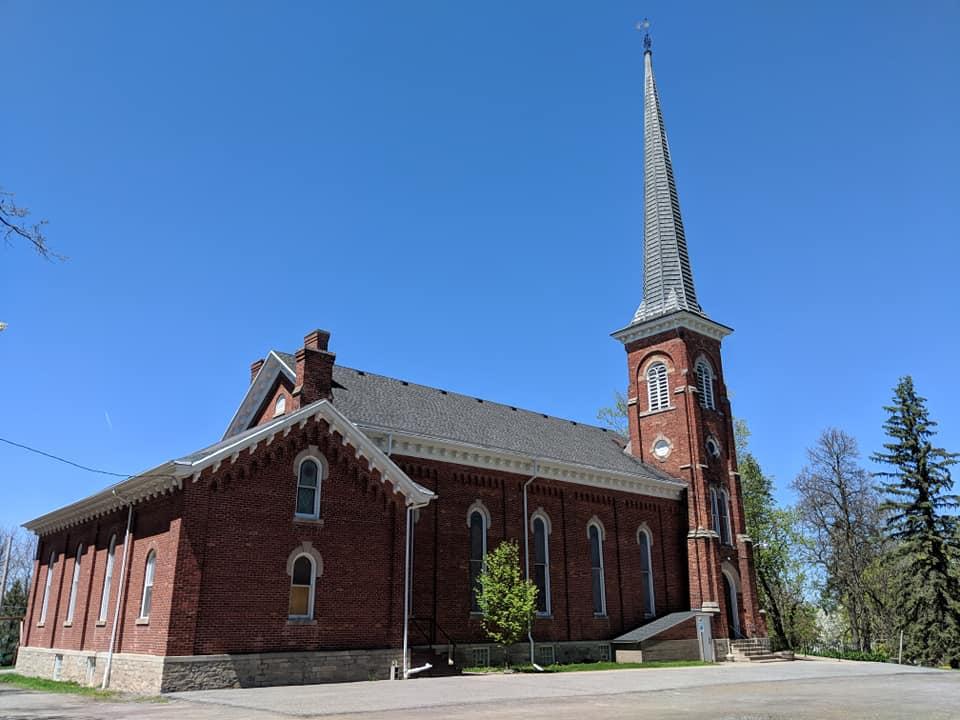
WEST BLOOMFIELD CONGREGATIONAL CHURCH, originally called the Religious Society of Bloomville, was founded by a small group of 19 settlers and six trustees in 1799. Meetings were held in an old school in what was then West Bloomville; they hired their first pastor in 1801. Their first church was deeded to them in 1806 for $60. In 1843, the congregation was dissolved and reinstituted as the Congregational Society of West Bloomfield, in keeping with the town’s change of name. Three years later, they built a new church of plastered brick, and after raising $13,430, T.S. Lynn built the current church in 1875. An active participant in the Underground Railroad as early as 1841, and a long-time advocate for women’s rights, it was one of the first churches to have a female pastor (ca. 1890).
An organ committee signed a contract in 1880 with William J. Davis & Company of Buffalo. Funds were raised by 26 parishioners, and the final cost came to $1,431.62. The organ was installed during the winter and early spring and on March 23, 1881, William J. Davis and an unnamed soprano performed the inaugural concert.
Davis was a former employee of the Roosevelt Organ Company, who formed his own small company in Buffalo at the end of the 19th century. Not related to the better known William Henry Davis & Son, W.J. Davis is not known to have built many instruments, and it is further uncertain just how long he was in business. Of the handful of instruments known to have existed, the Bloomfield organ is the only one extant. Like so many modest 19th-century instruments, it impresses not with power, but with a very well-balanced, rich, and colorful sound that comes from its eloquent 8′ stops and pyramidal tonal architecture.
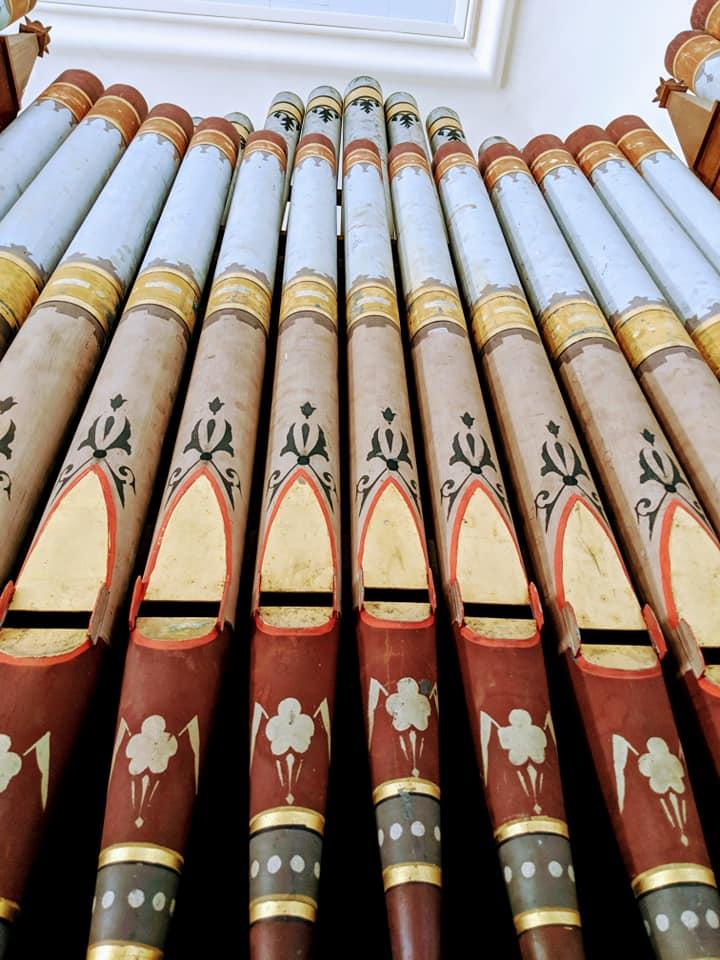
Affectionately nicknamed “Old Gal,” the Davis organ is contained within a single case 5′ deep by 12′ wide by 20′ high at the front, right corner of the sanctuary. The painted facade and sideboards are believed to be original, and are primarily colored light blue, ochre, brown, mauve, and yellow. Gold leaf, decorative stencils of fleur de lis, and red detail around the pipe mouths complete the organ's colorful decoration. The mahogany case is unusual in that it has been additionally incised with flower and angled line detail.
In the 1920s, Elon Shepard (the man instrumental in first obtaining the organ) left $500 in his will for the organ’s maintenance and the purchase of a half-horsepower Spencer blower for the organ, which up until that point had been pumped manually. The signatures of all the men and children who pumped the bellows from 1880 to 1920 can still be seen on the main internal support beams of the organ. At some point in the 1940s or 1950s, a current member of the congregation, then only twelve, noticed that the organ was sagging to its left side. The de Martinis family donated two jack-posts to elevate the metal support beams in the basement directly under the organ by giving them a quarter-turn every other month in the hopes of levelling the organ. The organ still leans; the jacks have not been turned in at least 20 years. In 1974, a cleaning, restoration, and regulation was undertaken by the Delaware Organ Company of Tonawanda that continued to maintain the organ biannually until the company closed in 1996. In 2010, Parsons completed a deep cleaning of the organ that included a standard regulation and tuning. Nothing mechanical or tonal was changed. A celebratory recital was given in honor of the organ’s reassembly on June 6, 2010. In April 2018, Parsons removed and regulated the Swell 8′ Oboe and repaired the original Tremulant — work facilitated by a generous anonymous donation. The church is very proud of “Old Gal” and it can be heard every Sunday played by organist Sue Belcher.
MARGARET-MARY OWENS
Database Manager on February 27th, 2017:
Updated by Scot Huntington, who has heard or played the organ.
At present, this is the only-known organ of William J. Davis left extant. Not related to builder William Henry Davis, William J. was a Buffalo, New York builder, once an employee of Hilborne Roosevelt.
Something missing or not quite correct?Add NoteorAdd WebpageorAdd Cross ReferenceorSuggest an Edit