William H. Clarke (& Co.)
1876
Roberts Park Methodist Church
401 N Delaware Street
Indianapolis, IN, US
48 Ranks - 2,606 Pipes
EXPLORE IMAGESVIEW STOPLISTSomething not quite correct?Suggest an Edit
🤝 Instrument entries in Indiana sponsored by:
We are grateful for the generous support of our sponsors, who make it possible for us to continue our mission of preserving and promoting the rich history of pipe organs across the globe.

IMAGES
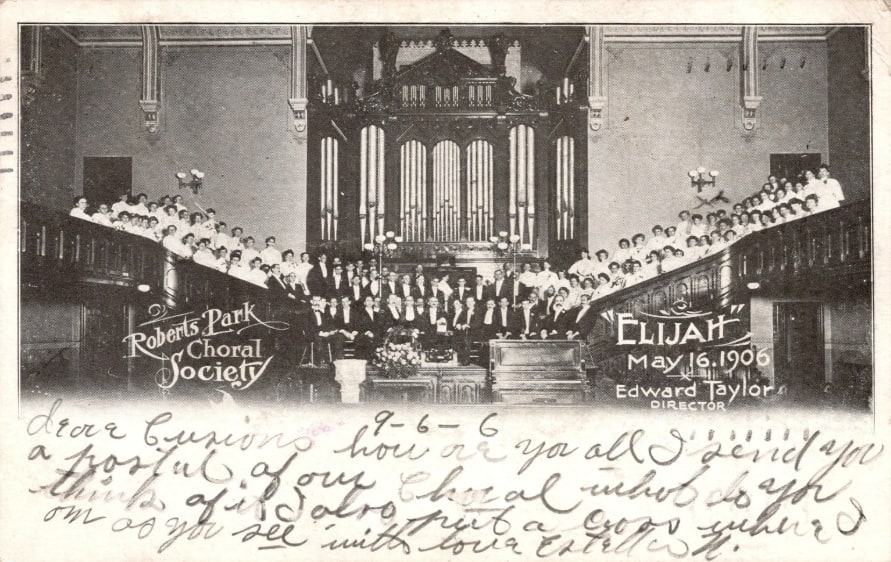
Something missing or not quite correct?Add ImageorSuggest an Edit
STOPLISTS
Something missing or not quite correct?Add Stoplist
CONSOLES
Builder: Unknown
Position: Unknown
Design: Unknown
Pedalboard Type: Unknown
Features:
3 Manuals (61 Notes)30 Note Pedal43 StopsMechanical (Unknown) Key ActionMechanical Stop ActionStop Layout: Unknown
Expression Type: Unknown
Combination Action: Unknown
Control System: Unknown or N/A
Something missing or not quite correct?Add ConsoleorSuggest an Edit
DETAILS
This instrument is: Not Extant and Not Playable in this location
On May 17, 1870, the quarterly conference of the church authorized use of a reed organ in worship. Dr. William L. Heiskell, a local dentist, organized a choir, which he directed for more than twenty years. Heiskell was a member of the committee that selected the first pipe organ for the new church. Wm. H. Clarke & Co. of Indianapolis supplied this instrument, which was inaugurated on Monday evening, June 12, 1876, with an "opening exhibition." The program featured Clarke as organist and the "Harmonic Society" and included selections from Sir Michael Costa's Naaman. The cost of the organ was $10,500. A letter in the Indiana Historical Society Library, dated February 23, 1876, to M.H. Haley of Crawfordsville, Indiana, from Wm. H. Clarke & Co. states that the factory was beginning work on this organ at this time, as it had just finished and shipped an organ to Lima, Ohio. The builder wrote to H.H. Wiser & Co., of Chicago, Illinois, March 21, 1876, inquiring about having two carvings made for this facade, the angels seen today, asking for a price in walnut and for a softer wood. A letter of April 25, 1876, from Wm. H. Clarke & Co. to Reverend C.D. Battiste [?] of Gallipolis, Ohio, notes that the Roberts Park organ was to be the "largest in the west outside of Chicago," with 60 stops [sic] and 2,606 pipes. Research by Michael Friesen notes the organ was shipped in May 1876. The black walnut case was twentythree feet wide and fifteen feet deep. Manual compass was sixty-one notes (CC-c4); pedal compass (flat pedalboard) was thirty notes (CC- £').
-- 2007 OHS Atlas
Database Manager on September 15th, 2012:
Updated through online information from T. Daniel Hancock. -- William Horatio Clarke writes in 1877, "A large Three-Manual Organ, containing 60 Draw-Stops, including 10 Pedal Registers, and is supplied with wind by Hydraulic power." This is followed by a testimonal [page (1)] from the church Pastor, Trustee Chair, and Organ Committee Chair.
Database Manager on November 24th, 2005:
Replaced by E. M. Skinner Opus 234 (1915), retaining the case.
Related Instrument Entries: Ernest M. Skinner Company (Opus 234, 1915) , Reuter Organ Co. (Opus 1781, 1973)
Something missing or not quite correct?Add NoteorAdd WebpageorAdd Cross ReferenceorSuggest an Edit