M. P. Möller
Opus 7836, 1949
St. Mary's Catholic Church
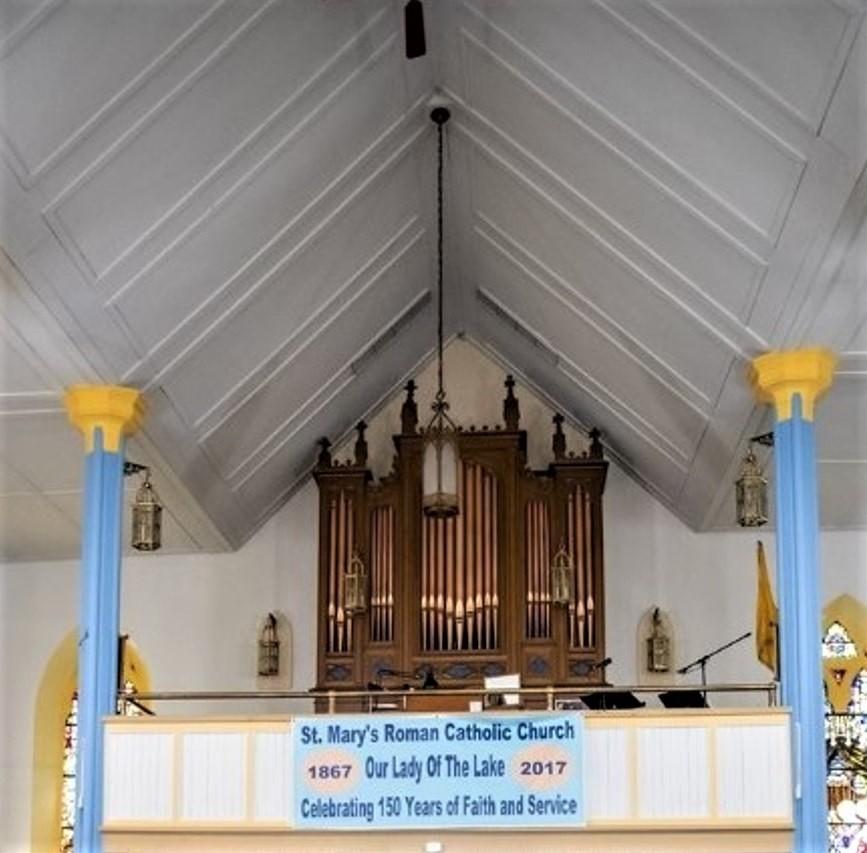
Sanctuary; rear gallery
31 Elm Street
Cooperstown, NY, US
5 Ranks - 377 Pipes
EXPLORE IMAGESVIEW STOPLISTSomething not quite correct?Suggest an Edit
IMAGES


Something missing or not quite correct?Add ImageorSuggest an Edit
STOPLISTS
Something missing or not quite correct?Add Stoplist
CONSOLES
Builder: M. P. Möller
Position: Console in Fixed Position, Center
Design: Traditional With Roll Top
Pedalboard Type: Concave Radiating (Meeting AGO Standards)
Features:
2 Manuals (61 Notes)32 Note Pedal3 Divisions5 Stops24 RegistersElectrical Key ActionElectrical Stop ActionCrescendoCombination Thumb Piston(s)Coupler Toe Piston(s)Stop Layout: Stop Keys Above Top Manual
Expression Type: Balanced Expression Shoes/Pedals (Meeting AGO Standards)
Combination Action: 'Hold and Set' Pneumatic/Mechanical
Control System: Unknown or N/A
Something missing or not quite correct?Add ConsoleorSuggest an Edit
DETAILS
This instrument is: ExtantandPlayable in this location
This extremely pedestrian organ replaced a noble instrument four times its size. Such is the wisdom of clergy. The Moller replaced a second-hand instrument attributed to E. & G.G. Hook (No. 14, 1834) moved here (it's third home) in altered condition by Steere & Turner (No. 224, 1886). The gilded zinc facade pipes, originally speaking and presently mute, are quite old - are at least as old as the Steere installation here and very possibly older. The antique case was reduced in depth and pushed back to allow more room in the gallery for a choir. The diminutive and quite mediocre Moller is a far cry from the substantial historic organ originally contained within this case, and the Moller instrument is largely located in the tower chamber, further diminishing its effectiveness. No antique Hook or Steere pipework was recycled in this instrument. Post-war shortages being what they were at the time, the 20th-century pipework in this instrument may have been new to this organ or recycled from other sources. The oak faux-grain treatment of the woodwork is original. The antique case is a valuable historic artifact.
In the 1970s, the organ was slightly enlarged and respecified by the Chase Organ Co. of nearby Worcester, New York. The Moller Diapason 8' was moved to a one-rank unenclosed unit chest, and a new brightly-voiced unit Principal 4' was put in its place on the enclosed chest, with the respecifying of that stop as upperwork.
Database Manager on September 23rd, 2019:
Updated by Matthew Dion, who has heard or played the organ. I visited this instrument on August 21st, 2019. The organ is in good condition and used regularly. I have a hunch that the pipes and case are from an older instrument in which Moller rebuilt in the 1940s. It is pitched higher than 440hz. The overall specification is quite strange. The only two stops on the Gt that are unenclosed are the Open Diapason 8\' and the Octave 4\'. The rest are borrowed from the Swell division.
Database Manager on April 28th, 2008:
Identified from factory documents and publications courtesy of Stephen Schnurr.
Related Instrument Entries: Chase Organ Co. (Sidney Chase) (1978 ca.)
Something missing or not quite correct?Add NoteorAdd WebpageorAdd Cross ReferenceorSuggest an Edit