Rostron Kershaw
1956
Originally Jesse Woodberry (& Co.) (Opus 274, 1900ca.)
Sacred Heart Roman Catholic Church
1321 Centre Street
Newton Centre, MA, US
28 Ranks - 1,475 Pipes
Something not quite correct?Suggest an Edit
🤝 Instrument entries in Massachusetts sponsored by:
We are grateful for the generous support of our sponsors, who make it possible for us to continue our mission of preserving and promoting the rich history of pipe organs across the globe.

IMAGES





Something missing or not quite correct?Add ImageorSuggest an Edit
STOPLISTS
Something missing or not quite correct?Add Stoplist
CONSOLES
Builder: Unknown
Position: Console in Fixed Position, Center
Design: Traditional With Roll Top
Pedalboard Type: Concave Radiating (Meeting AGO Standards)
Features:
2 Manuals (61 Notes)32 Note Pedal3 Divisions40 Stops24 RegistersElectrical Key ActionElectrical Stop ActionCrescendoCombination Thumb Piston(s)Combination Toe Piston(s)Coupler Thumb Piston(s)Coupler Toe Piston(s)Sforzando Thumb Piston(s)Sforzando Toe Piston(s)Stop Layout: Stop Keys Above Top Manual
Expression Type: Balanced Expression Shoes/Pedals (Meeting AGO Standards)
Combination Action: Adjustable Combination Pistons
Control System: Unknown or N/A
Something missing or not quite correct?Add ConsoleorSuggest an Edit
DETAILS
This instrument is: Extant and Playable in this location
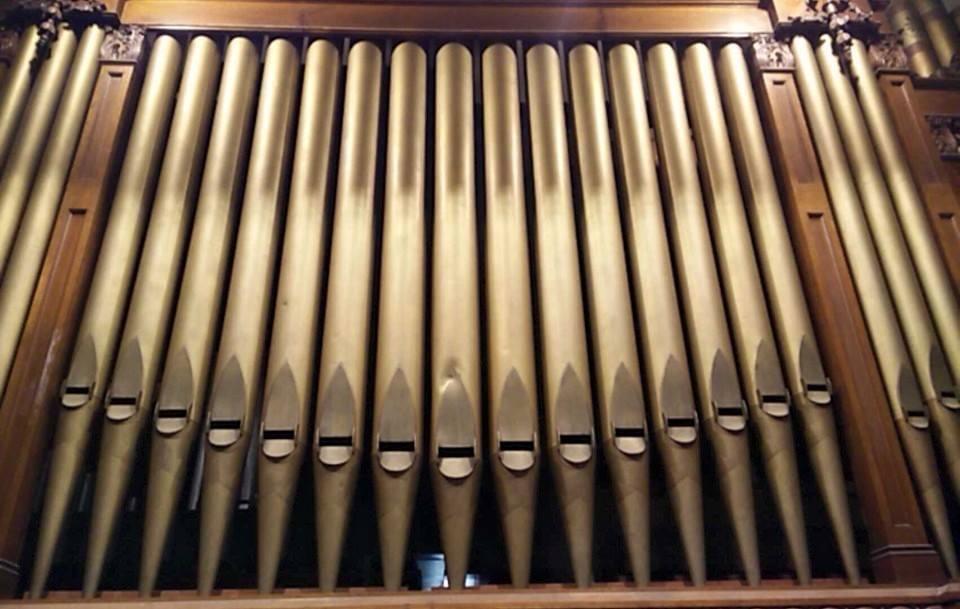
The chests are Woodberry, with electro-pneumatic pulldown machines and stop action by Kershaw. There are now numerous e-p offset and unit chests added by Kershaw for the facade, Principal 16', Swell 16' Bourdon, Swell Nazard/Piccolo unit, and Pedal treble extensions. The original double-rise reservoir is in place, releathered well by Kershaw, but now with metal ducting. The unenclosed Great was enclosed in a masonite Swell box by Kershaw, but the shades and expression motor are now removed. The Great Principal 16' originally stood on the main chest with the bottom octave tubed off, and now stands on two unit chests by Kershaw. The Swell Bourdon 16' originally had a double slider for treble and bass (1-12), and these pipes also now stand on Kershaw unit chests. The original pipes are all marked with the no. 274.
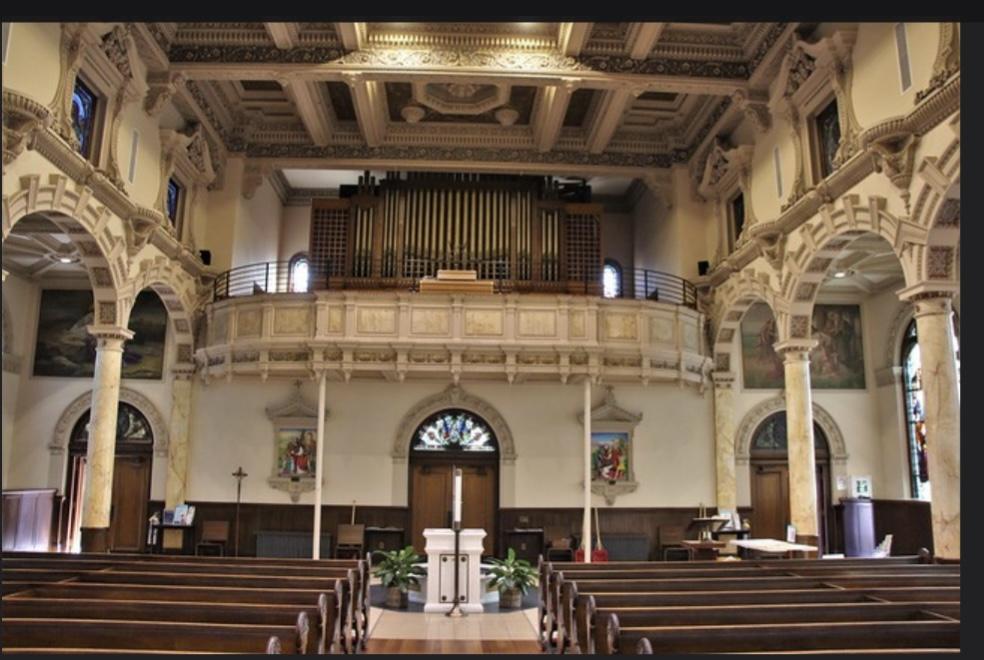
The organ is powered by a 1 h.p. Spencer blower from the 1920s. There is an unconfirmed legend in the church the organ was second hand, but the oak case looks custom-built for this gallery location. The diatonic "M" chests are placed horizontally, Great on the left, Swell on the right, with the 3-stop pedal "A" chest across the rear. The pipework is very high quality and the voicing is very fine for the period, the Great chorus being rather brilliant. The reed shallots all have tinned exterior surfaces.
The all-electric console is Kershaw built, with patent permission from Austin. The oak casework shows no evidence of an attached console, so the original console would have been detached. Given its age, the action could have been either mechanical or tubular-pneumatic. The pedal chest is pneumatic, potentially a ventil chest, and of the same age as the main chests, giving credence to the possibility that the organ was pneumatic and not a tracker.
Database Manager on September 15th, 2008:
Identified through online information from James R. Stettner. -- This was the electrification on new chests of the existing Jesse Woodberry & Co. organ with tonal changes and additions. The Pedal 16' Open Diapason [wood] and 8' Cello remained 30 pipes even though the pedalboard was 32-notes. The 16' Bourdon, however, was extended and unified to 16-8-4. The organ was scheduled to be re-trackerized by Andover. Source: extant organ documented June 26, 1989.
Webpage Links: Pelland Organ company
Something missing or not quite correct?Add NoteorAdd WebpageorAdd Cross ReferenceorSuggest an Edit