Steiner-Reck Organ Co.
1993
St. John Lutheran Church (1980)
824 Fredonia Avenue
Fredonia, WI, US
13 Ranks
EXPLORE IMAGESVIEW STOPLISTSomething not quite correct?Suggest an Edit
IMAGES
Something missing or not quite correct?Add ImageorSuggest an Edit
STOPLISTS
| GREAT (I - Expressive) | ||
| 8' | Principal | |
| 8' | Rohrfloete | |
| 4' | Octave | |
| 2' | Klein Principal | |
| 1 1⁄3' | Mixture | |
| 8' | Trumpet | |
| Chimes | ||
| 8' | SWELL to GREAT |
| SWELL (II - Expressive) | ||
| 8' | Gemshorn | |
| 4' | Traverse Flute | |
| 2 2⁄3' | Nazard | |
| 8' | Trumpet |
| PEDAL | ||
| 16' | Subbass | |
| 8' | GREAT to PEDAL | |
| 8' | SWELL to PEDAL |
Maas Cathedral Chimes (25 notes) [originally received from Brian Heinlein 2014-03-02.]
Open In New TabSomething missing or not quite correct?Add StoplistorSuggest an Edit
CONSOLES
Builder: Steiner-Reck Organ Co.
Position: Keydesk Attached
Design: Traditional Without Cover
Pedalboard Type: Concave Radiating (Meeting AGO Standards)
Features:
2 Manuals (58 Notes)32 Note Pedal11 StopsMechanical (Unknown) Key ActionMechanical Stop ActionHitchdown Coupler(s)Stop Layout: Unknown
Expression Type: Balanced Expression Shoes/Pedals (Details Unknown)
Combination Action: None
Control System: Unknown or N/A
Something missing or not quite correct?Add ConsoleorSuggest an Edit
DETAILS
This instrument is: ExtantandPlayable in this location
from the Church History page:
The Steiner-Reck Organ
The passing years continued to exert a toll on the aging parts of the combined Schaefer-Haase organ. Necessary repairs would be expensive and not improve the sound or range of the instrument. An Organ Committee was appointed to investigate all options. Dr. John Behnke of Concordia University Wisconsin was hired as an organ consultant.
The committee examined the pro’s and con’s of electronic, electro-pneumatic, and “tracker” (mechanical connections between the keys and pipes) organs. Eventually, their recommendation was to pursue the “tracker”-type option as being the most durable and cost-effective over time, as well as being esthetically the most pleasing. Dr. Benke drew up a basic design that outlined the basic parameters of the new instrument and the capabilities it needed to have to suit the congregation’s purposes. He also recommended three builders who were given the opportunity to design specific proposals. After much study, discussion and debate, the committee recommended the purchase of a new 13-rank organ to be built by the Steiner-Reck Company of Louisville, KY. The recommendation to purchase this organ passed the Voters’ Assembly on March 19, 1991. It would take three years to build and cost $103,000. In addition, the choir loft (balcony) had to be rebuilt at a cost of an additional $2,054 and 528 hours of time donated by members! The congregation organized its own capital campaign to cover the costs and the members responded generously with sacrificial gifts both small and large to make it happen. The organ would not be delivered until September of 1993.
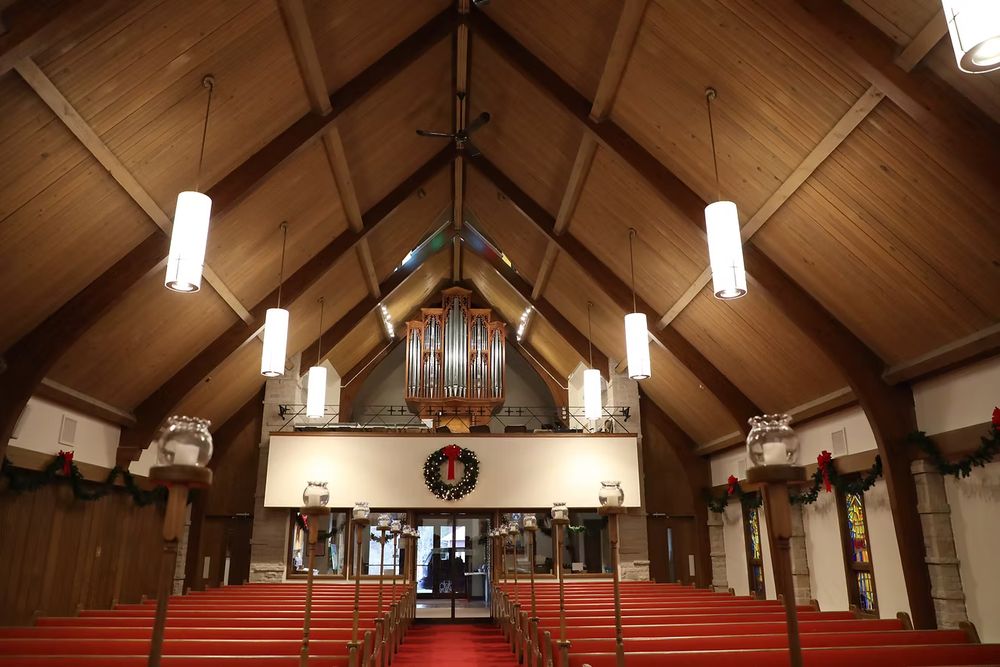
The organ was completely assembled at the factory in Louisville, then disassembled and packed into panel trucks for delivery. A team of craftsmen from the company, led by organ builder Gottfried Reck, drove the trucks to Fredonia arriving on a Sunday afternoon. Large plywood sheets, some covered in green felt, were placed over all of the pews, then members of the congregation along with the factory workers carried the hundreds of pieces, big and small, into the church and laid them out upon the plywood. It looked as if a large, 3-dimensional puzzle was about to be constructed, which was pretty much the case. The builders spent the entire week reassembling the organ so that services could be conducted in the sanctuary the following Sunday. The organ was not yet ready to play, but it was put together! Everyone marveled at the beauty and exquisite craftsmanship of the organ case. Later, Gottfried Reck returned with various assistants to first “voice” and then “tune” the instrument.
Finally, the organ was formally dedicated to the glory of God and the service of His Church at the Sunday morning worship services on October 24, 1993. That evening Dr. Behnke played a dedicatory recital highlighting the various capabilities of the new organ which was primarily designed to lead and worshipfully augment congregational singing and liturgy in the Lutheran tradition.
Database Manager on March 6th, 2014:
Updated through online information from Brian Heinlein.
Database Manager on October 30th, 2004:
Status Note: There 1994
Database Manager on October 30th, 2004:
All ranks except 8' Principal are under expression. Wind pressure: 65mm. [Previously had a 1933 Schaefer organ, 2m., Op. 149b.]
Something missing or not quite correct?Add NoteorAdd WebpageorAdd Cross ReferenceorSuggest an Edit