Schlicker Organ Co.
1974
State Teacher College [now SUNY Freedonia] (1941)
Teaching studio, Mason Hall
280 Central Avenue
Fredonia, NY, US
26 Ranks - 1,417 Pipes
Something not quite correct?Suggest an Edit
IMAGES
Something missing or not quite correct?Add ImageorSuggest an Edit
STOPLISTS
| Great (II) | ||
| 8' | Rohrgedeckt | 61 |
| 4' | Principal | 61 |
| 2' | Waldfloete | 61 |
| III-IV | Mixture 1⅓' | 232 |
| 16' | Dulzian | 61 |
| 8' | Swell to Great | |
| 8' | Positiv to Great |
| Swell (III - Expressive) | ||
| 8' | Quintadena | 61 |
| 8' | Salicional [tc] | 49 |
| 4' | Spitzfloete | 61 |
| 2' | Nachthorn | 61 |
| III | Scharf 1' | 183 |
| 8' | Schalmei | 61 |
| Tremolo |
| Positiv (I) | ||
| 8' | Holzgedeckt | 61 |
| 4' | Rohrfloete | 61 |
| 2⅔' | Quint | 61 |
| 2' | Principal | 61 |
| 1⅗' | Terz | 61 |
| Tremolo | ||
| 8' | Swell to Positiv |
| Pedal | ||
| 16' | Subbass | 32 |
| 8' | Offenbass | 32 |
| 4' | Dolkan | 32 |
| 16' | Fagott | 32 |
| 4' | Kornett | 32 |
| 8' | Swell to Pedal | |
| 8' | Great to Pedal | |
| 8' | Positiv to Pedal |
Originally Written/Published: 2013-01-08
Open In New TabSomething missing or not quite correct?Add StoplistorSuggest an Edit
CONSOLES
Builder: Schlicker Organ Co.
Position: Detached Keydesk (Mechanical Action)
Design: Non-Traditional Style, As Consoles by Holtkamp, Schlicker, et al
Pedalboard Type: Concave Radiating (Meeting AGO Standards)
Features:
3 Manuals (61 Notes)32 Note Pedal4 Divisions21 Stops26 RegistersMechanical (Balanced Tracker) Key ActionElectrical Stop ActionCombination Thumb Piston(s)Combination Toe Piston(s)Coupler Thumb Piston(s)Coupler Toe Piston(s)Sforzando Toe Piston(s)Stop Layout: Tilting/Rocking Tablets Above Top Manual
Expression Type: Balanced Expression Shoes/Pedals (Meeting AGO Standards)
Combination Action: 'Hold and Set' Pneumatic/Mechanical
Control System: Unknown or N/A
Something missing or not quite correct?Add ConsoleorSuggest an Edit
DETAILS
This instrument is: Extant and Playable in this location
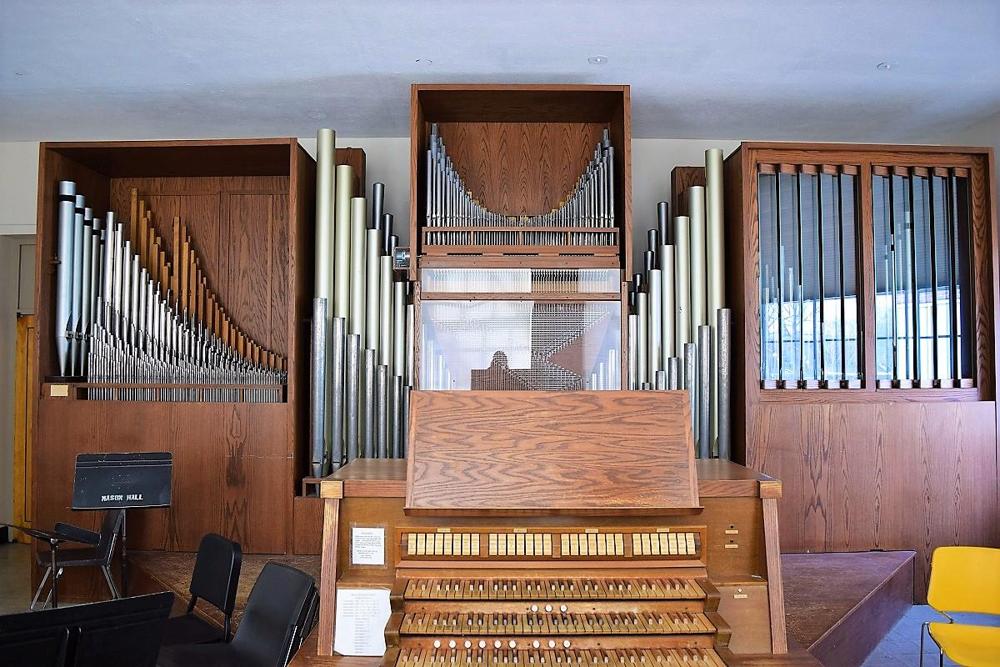
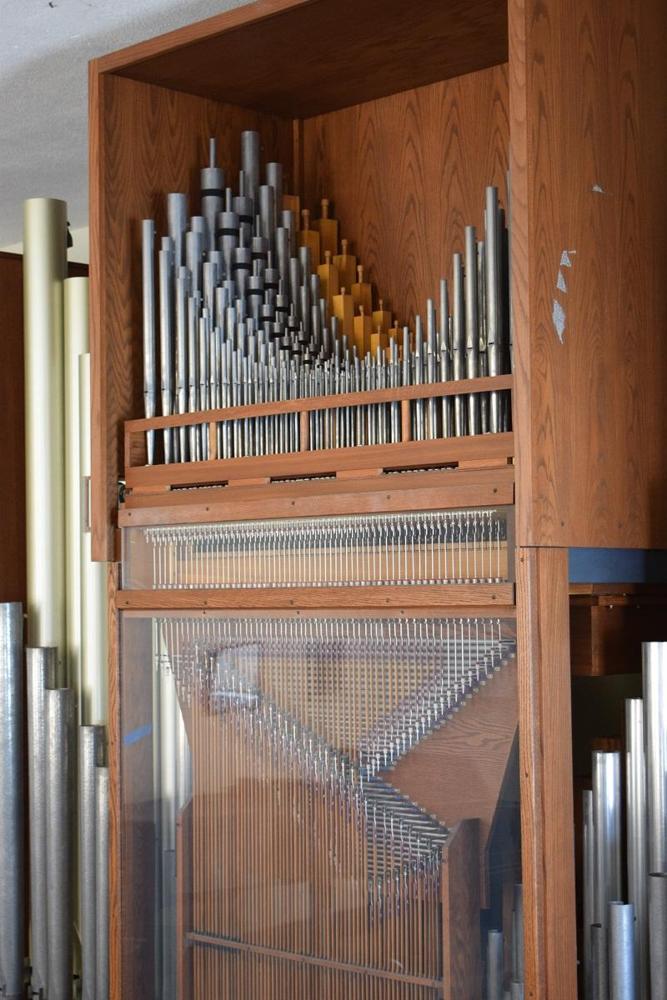
As of 2024, the instrument is used occasionally for student lessons and practice, for organ as a second instrument but organ is no longer available as a major. The wood covers over the exposed Positiv action are long gone, and the organ is in decent playing condition at the age of 50, although badly in need of tuning and action rationalization. The capture combination action and vacuum stop action are also in need of adjustment. The 1 HP Meidinger blower received a new motor in 1977 after the organ was only three years old, and replaced entirely with a 0.75 HP Ventus at an unknown date, but presumably as part of the 2000 refurbishment. The blower oiling record ends in 1997. The Music building at Fredonia consists of Old Mason (ca. 1948), the Mason Annex addition, circa late 1960s, and the New Mason addition, 1972. To correct my previous entry, this organ was intended for the teaching studio as part of the three-room organ suite on the third floor of New Mason, not the Annex as I stated. This complex was enlarged again in 2015 with two additional rehearsal halls and connected to the King Concert Hall. Now known simply as Mason Hall, the building containing the Schlicker studio organ will be gutted to the studs in 2025, and rebuilt with a new layout, "Green" temperature control including A/C, and enhanced mobility access. It is anticipated the organ will be removed at the end of the 2024-25 school year. Whether the organ is returned to the building, moved to another building within the community, or sold outright, is now the subject of vigorous discussion. While it is hoped the organ will be returned and organ reinstated as a curriculum major, this is only one of several options, and funding will be the determining factor. 50 years of heavy use have taken their toll on the keyboards, but the rest of the instrument is in surprisingly good condition, a testament to the quality of the original instrument.
Database Manager on January 10th, 2013:
Updated through online information from Scot Huntington. -- Originally intended for a teaching studio in the music building annex completed in 1973, it was determined the room was not wide enough to accommodate an instrument of the desired size, so a former classroom in the old music building was commandeered for the purpose. The organ was delivered in January, 1974, three months behind schedule. The final cost was $51,000, the contract awarded by the comptroller's office in Albany through a sealed bidding process. The organ was laid out horizontally against one wall, with a detached console and an instrumental performance platform installed above the tracker chase. The manual divisions were encased in reflective polished oak furniture veneer plywood boxes, and the pedal was unenclosed in the center of the instrument. The layout was, left to right: Great; Pedal with Positiv above; Swell. The Great and Swell were laid out chromatically, and the Positive and Pedal were diatonic. The rollerboard to the Positiv and its bungboard were originally covered with plexiglass to facilitate watching the key action function, but were later covered with wooden covers in the 1980s. The mechanically operated, horizontal Swell shutters were thick glass. The blower, static reservoir, and vacuum motor were in the Xerox room across the hall and the wind line passes above the hall ceiling. The wind regulation is by schwimmers attached to the pallet boxes of each windchest. The stop motors are vacuum operated pistons. The combination action was hold & set. The organ was installed and voiced on-site by Louis Rothenburger Jr. and David Dickson. The organ was dedicated by Fredonia organ majors with Hermann Schlicker and several prestigious, prospective clients in attendance. In the early 1980s, at the request of Dr. John Hofmann, Professor of organ, the Positive Principal 2' and Swell Nachthorn 2' exchanged places. The organ was designed by John Hofmann in consultation with Hermann Schlicker and Ken List.
Database Manager on July 8th, 2011:
Updated through online information from Vince Harzewski.
Database Manager on May 25th, 2006:
Updated through online information from Ken Klocek. -- Refurbished by Heritage Pipe Organs of North Tonawanda, year 2000.
Database Manager on October 30th, 2004:
This entry represents the installation of a new organ. General combinations.
Something missing or not quite correct?Add NoteorAdd WebpageorAdd Cross ReferenceorSuggest an Edit