Hope-Jones Organ Co.
Opus 10, 1910
St. John the Evangelist Episcopal Church (1895 & 1902)
60 Kent Street N
St. Paul, MN, US
15 Ranks - 1,203 Pipes
EXPLORE IMAGESVIEW STOPLISTSomething not quite correct?Suggest an Edit
IMAGES
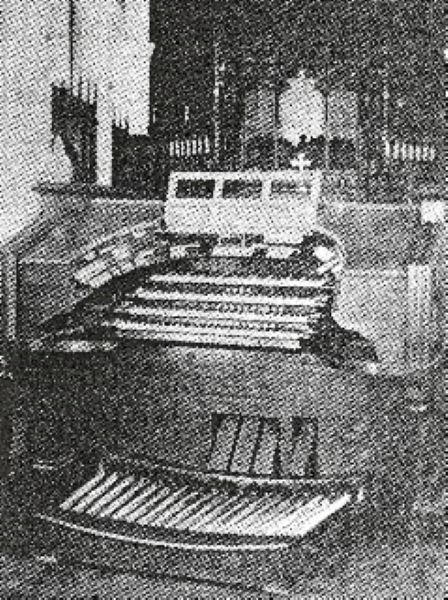
Something missing or not quite correct?Add ImageorSuggest an Edit
STOPLISTS
Something missing or not quite correct?Add Stoplist
CONSOLES
Builder: Hope-Jones Organ Co.
Position: Unknown
Design: Horseshoe
Pedalboard Type: Concave Radiating (Details Unknown)
Features:
4 Manuals (61 Notes)32 Note Pedal4 Divisions15 Stops68 RegistersElectrical Key ActionCrescendoCombination Thumb Piston(s)Stop Layout: Stop Keys in Horseshoe Curves
Expression Type: Balanced Expression Shoes/Pedals (Details Unknown)
Combination Action: Adjustable Combination Pistons
Control System: Unknown or N/A
Something missing or not quite correct?Add ConsoleorSuggest an Edit
DETAILS
This instrument is: Not ExtantandNot Playable in this location
From The Diapason, February 1, 1910: ST PAUL CHURCH HAS INSTALLED BIG ORGAN WITH NEW FEATURES
Hope-Jones Company Places Four-Manual Instrument Having Specification Which is Attracting Attention.
The Diapason, February 1, 1910
St Paul, Minn. Jan 24. Attention has been attracted throughout the Northwest by the organ just installed in the Church of St John the Evangelist by the Hope-Jones Organ Company. George H. Fairclough is the organist of this church. The organ chamber to the south of the choir, extending over the ambulatory on that side and in a chamber built over the corresponding ambulatory on the north side, every stop being enclosed in one of the four massive concrete and tile boxes or chambers, including the pedal organ. The ceiling of these chambers are formed in a parabola, focused to direct the tone into the choir and nave and diffuse it in such a manner that its source is not obvious.
Control of the organ is from a console in the choir opposite the larger division of the instrument, and is electro-pneumatic according to the Hope-Jones practice. The swells laminated shutters with sound-proof joints are operated from four pedals, with a “general” pedal to which any or all may be coupled and have indicators above the manuals which show at all times the position of the various shutters and from which they may be operated upon occasion the mechanism responding to the lightest touch of the finger.
The console is provided with Hope-Jones “stop-keys”, “double-touch” to manuals, ten adjustable combination pistons to each manual also having the double-touch and being provided with the patented “suitable-bass” control for optional use. Inclined manuals, concave and radiating pedals, the extension of the coupled manuals an octave above the compass of the keys, the effective engine, tremulants and other features introduced by Hope-Jones are in evidence, and the keys, stops and all mechanism and arranged to swing up and support themselves, exposing every contact as easily as the lid of a piano is opened for playing. Wind is furnished at three pressures, from five to twenty-five inches by a Kinetic blower.
Curiously, the organ which this displaces was erected in the original church by J.T. Austin, now president of the Austin Organ Company and R. P. Elliot, president of the Hope-Jones Organ Company, being there a pioneer pneumatic organ of the Farrand & Votey firm, long since out of the pipe organ field, the date being about 1891.
Database Manager on March 7th, 2009:
Updated through online information from Richard C Greene.
Database Manager on February 8th, 2009:
This entry represents the installation of a new organ. Identified through online information from Richard C Greene: Source: Diapason, February 1, 1910.
Webpage Links: Twin Cities AGO: Organ List
Something missing or not quite correct?Add NoteorAdd WebpageorAdd Cross ReferenceorSuggest an Edit