Charles Viner & Son
Opus 158, 1906
First Presbyterian Church
64 East Main Street
Gowanda, NY, US
11 Ranks
EXPLORE IMAGESVIEW STOPLISTSomething not quite correct?Suggest an Edit
IMAGES
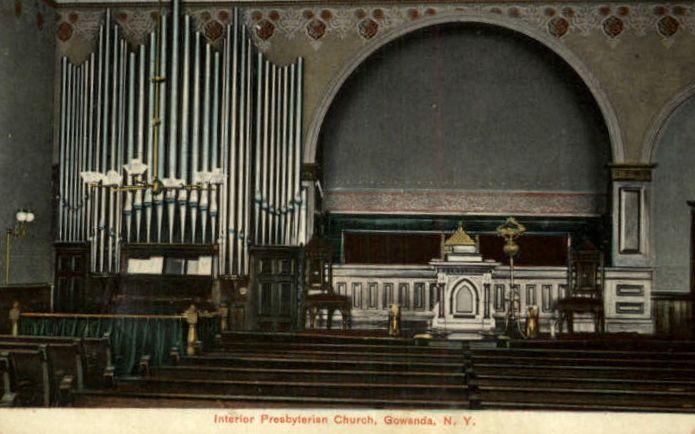
Something missing or not quite correct?Add ImageorSuggest an Edit
STOPLISTS
Something missing or not quite correct?Add Stoplist
CONSOLES
Builder: Unknown
Position: Unknown
Design: Unknown
Pedalboard Type: Unknown
Features:
Stop Layout: Unknown
Expression Type: Unknown
Combination Action: Unknown
Control System: Unknown or N/A
Something missing or not quite correct?Add ConsoleorSuggest an Edit
DETAILS
This instrument is: ExtantandPlayable in this location
An old stereo slide of the church interior available on Ebay, shows a one-manual pipe top Mason & Hamlin reed organ in the arch to the left of the altar. This organ is described in the Charles Viner ledger held on the American Organ Archives. Viner bought the failed Garret House company circa 1898 and continued House's opus numbering. The first new Viner organ appears in the ledger as No. 146, 1900, so this instrument would be somewhere between 1901-03. Viner introduced mechanical-action ventil chests several organs earlier, and the instruments definitively fitted with that form of action is identified in the spec pages as having "individual valves" or "ventil stop action". This organ is not so identified so likely had slider chests. The organ was originally fitted with a "Ross Water Engine #4 Long", and Viner installed a Spencer Orgoblo 1/3 HP, 110 volt motor. There is a pencil notation that Viner gave the church an insurance appraisal of $3,500 in 1933. Viner's cost for the new organ was "1575 + 168=1743". The case is nearly identical to the extant instrument in the Congregational Church Bergen, New York, No. 161, three organs later. Viner worked as a voicer with Johnson & Son from 1890-1896, recording the scales of every organ in his ledger. His first organs on his own are tonally identical to Johnson's instruments of the 1890s.
Facebook photos of the church interior (2021) show no evidence of this organ or the former chancel architecture seen in the 1912 postcard image. The niche where the organ sat is gone and replaced by a door. There is now a divided chancel arrangement of choir pews facing each other and the altar, and a cloth grill above the altar which may be covering an organ chamber, or perhaps it's speaker camouflage.
Database Manager on July 26th, 2012:
Identified through online information from Will Dunklin. -- Cost $2000 of which $750 came from Andrew Carnegie.
Related Instrument Entries: Schlicker Organ Co. (1952)
Something missing or not quite correct?Add NoteorAdd WebpageorAdd Cross ReferenceorSuggest an Edit