Steere & Turner [John S. Steere]
Opus 131, 1879
Immaculate Conception Roman Catholic Church
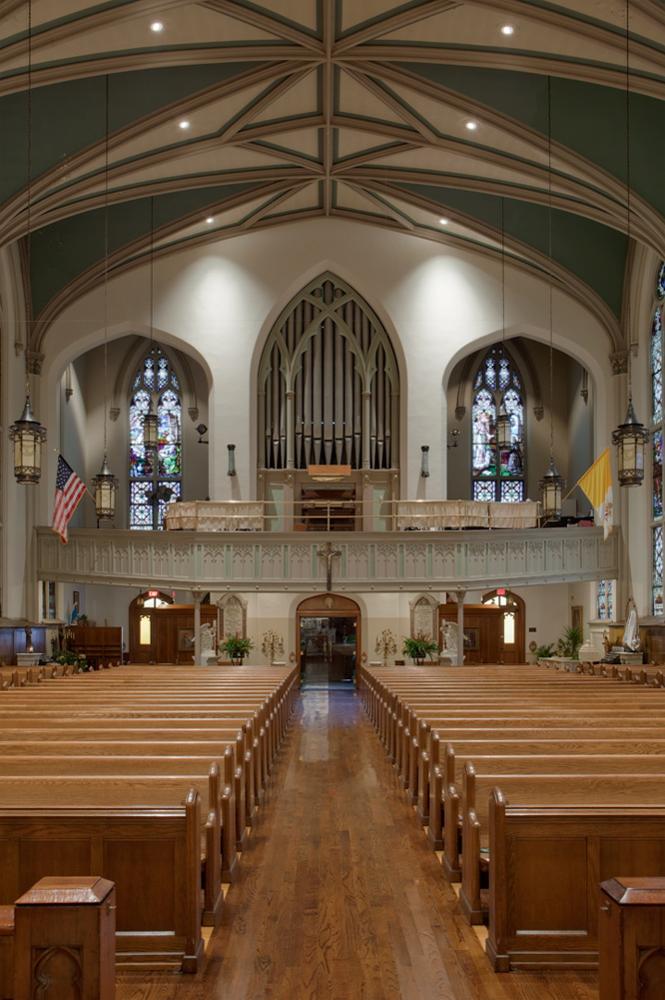
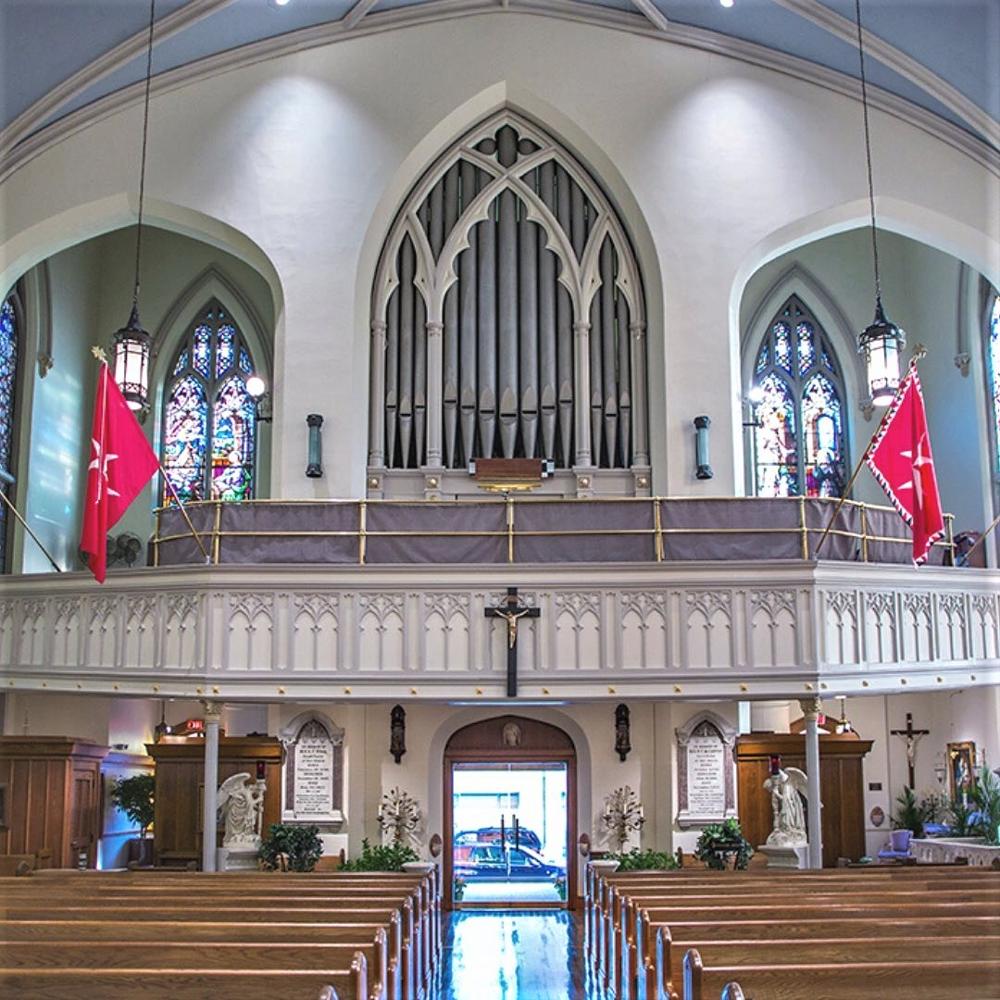
Sanctuary; rear gallery
8th Street & N Street NW
Washington, DC, US
29 Ranks - 1,586 Pipes
Something not quite correct?Suggest an Edit
IMAGES
Something missing or not quite correct?Add ImageorSuggest an Edit
STOPLISTS
| GREAT | ||
| 16' | Open Diapason | |
| 8' | Open Diapason | |
| 8' | Viole de Gamba | |
| 8' | Dulciana | |
| 8' | Melodia | |
| 8' | Stopped Diapason | |
| 4' | Octave | |
| 4' | Flute Harmonic | |
| 2⅔' | Twelfth | |
| 2' | Fifteenth | |
| 1⅓' | Mixture III | |
| 8' | Trumpet | |
| 8' | Clarinet (t.c.) |
| Unknown |
| SWELL | ||
| 16' | Bourdon | |
| 8' | Open Diapason | |
| 8' | Salicional | |
| 8' | Stopped Diapason | |
| 4' | Violina | |
| 4' | Waldflute | |
| 2' | Cornet III | |
| 8' | Oboe & Bassoon | |
| 8' | Vox Humana | |
| Tremulo |
| PEDAL | ||
| 16' | Double Open Diapason | |
| 16' | Double Stopped Diapason | |
| 8' | Violoncello |
| COUPLERS | ||
| 1st Manual to Pedal | ||
| 2nd Manual to Pedal | ||
| 1st to 2nd Manual |
| COMBINATION PEDALS | ||
| 2nd Forte, Mezzo, Piano | ||
| 1st to Ped Rev, Swell | ||
| 1st Piano, Mezzo, Forte |
Something missing or not quite correct?Add StoplistorSuggest an Edit
CONSOLES
Builder: Steere & Turner [John S. Steere]
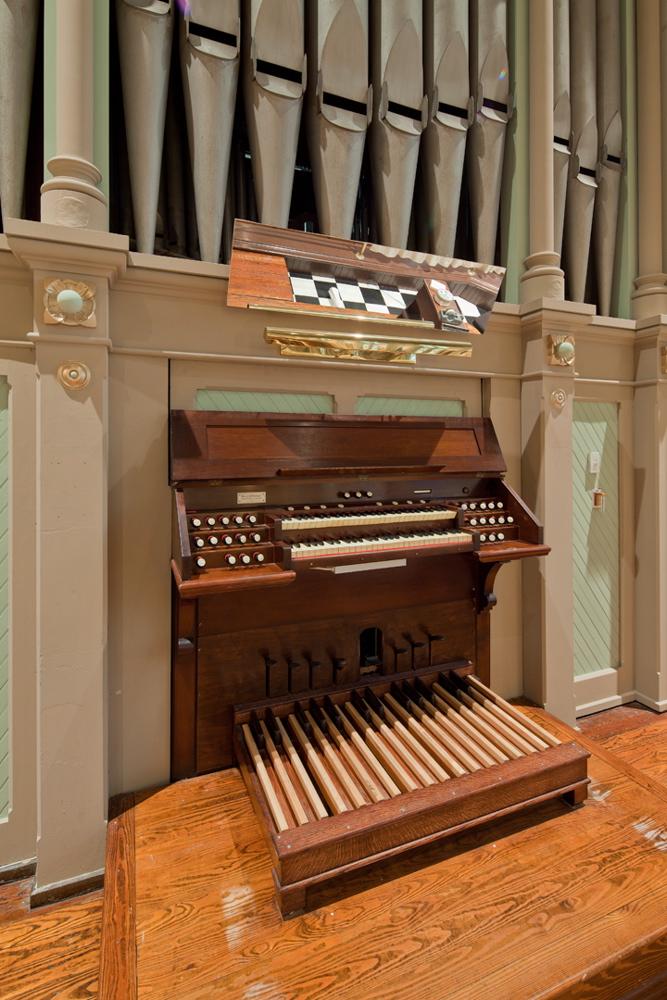
Position: Keydesk Attached
Design: Traditional With a Keyboard Cover That Can Be Lifted To Form a Music Rack
Pedalboard Type: Flat Straight
Features:
2 Manuals (58 Notes)30 Note Pedal3 Divisions25 Stops25 RegistersMechanical (Unknown) Key ActionMechanical Stop ActionCombination Trundle(s)Coupler Trundle(s)Stop Layout: Drawknobs in Horizontal Rows on Terraced/Stepped Jambs
Expression Type: Balanced Expression Shoes/Pedals (Details Unknown)
Combination Action: Fixed Mechanical
Control System: Unknown or N/A
Something missing or not quite correct?Add ConsoleorSuggest an Edit
DETAILS
Exhibited in the 1964, 2011 OHS convention(s)
This instrument is: Extant and Playable in this location
The present Steer & Turner organ, Opus 131, was installed in 1879. An electric blower was probably installed in the tower in 1936 when the building was completed. On the recommendation of Fr. George Gleason of Baltimore, a respected organ consultant, the original flat pedalboard was replaced in 1951 with a 32-note AGO radiating and concave type. In 1954, the Newcomer Organ Company replaced the original double-fold reservoir with standard Möller reservoirs. Newcomer listed the organ as a Wm. Bardroff and the Baltimore firm replaced the stop tablets when the organ was under its care. The organ was so identified during the 1964 OHS Convention and then it was discovered that indeed, it was a Steer & Turner. In 1977, the organ was partly refurbished by Lewis & Hitchcock. This project reversed some of the unsatisfactory 1973 restorative work. Further work was done by Central Pipe Organ Service, including the replacement of the AGO pedalboard with a flat 30-note pedalboard similar to the original. -- 2011 OHS Atlas
Database Manager on April 6th, 2013:
Updated through online information from Chad Hrdina.
Something missing or not quite correct?Add NoteorAdd WebpageorAdd Cross ReferenceorSuggest an Edit