🤝 Instrument entries in New Jersey sponsored by:
We are grateful for the generous support of our sponsors, who make it possible for us to continue our mission of preserving and promoting the rich history of pipe organs across the globe.

IMAGES
Something missing or not quite correct?Add ImageorSuggest an Edit
STOPLISTS
No stoplist details are available. If you have stoplists, please consider sharing them with us.
Something missing?Add Stoplist
CONSOLES
Builder: Unknown
Position: Unknown
Design: Unknown
Pedalboard Type: Unknown
Features:
Stop Layout: Unknown
Expression Type: Unknown
Combination Action: Unknown
Control System: Unknown or N/A
Something missing or not quite correct?Add ConsoleorSuggest an Edit
DETAILS
This instrument is: Extant and Playable in this location
This entry describes an original installation of a new pipe organ. Identified by William Dunklin, using information from this web site: http://www.catchthespirit.org/wp-content/uploads/2015/08/A-great-Throng-Attends-the-Dedicatory-Exercise-of-Trinity-Church-June-1888.pdf.
A newspaper article from the Hackettstown Gazette, June 8, 1888, describes the church's dedication events in preceding week, including an opening organ recital on Monday, June 4, 1888:
"On Monday night the general public was first admitted to the church, the occasion being the organ opening concert, at which Mr. Wenham Smith, organist of Plymouth Church, Brooklyn, and the Courtney Ladies- Quartette, of New York, appeared. There were between 700 and 800 persons present, and the entertainment was one of the most delightful and thoroughly enjoyed musical events that had ever taken place here.
"That Mr. Smith is a master of the instrument is a fact fully established by the position he holds, and he showed excellent taste in his renderings, selecting not only those that required skillful manipulation, but that were also melodious and that could be understood without taking a three years- course at the conservatory of music."
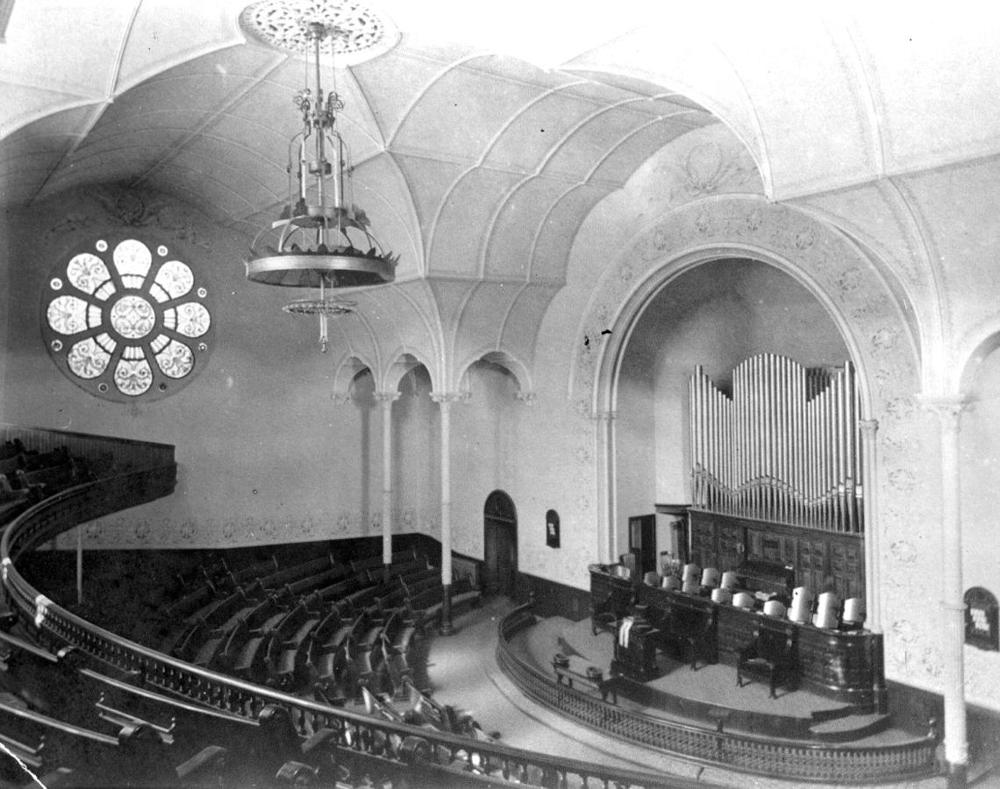
A postcard from 1905 shows a simple pipe fence facade above an equally simple frame and panel case, standing front and center in a tall arch. The attached console is visible. The organ reportedly removed during or after World War II.
Something missing or not quite correct?Add NoteorAdd WebpageorAdd Cross ReferenceorSuggest an Edit