Henry Pilcher's Sons
Opus 829, 1960
Originally Henry Pilcher's Sons (1914)
Second Baptist Church
615 South Wittenberg Avenue
Springfield, OH, US
EXPLORE IMAGESSomething not quite correct?Suggest an Edit
🤝 Instrument entries in Ohio sponsored by:
We are grateful for the generous support of our sponsors, who make it possible for us to continue our mission of preserving and promoting the rich history of pipe organs across the globe.

IMAGES
Something missing or not quite correct?Add ImageorSuggest an Edit
STOPLISTS
No stoplist details are available. If you have stoplists, please consider sharing them with us.
Something missing?Add Stoplist
CONSOLES
Builder: Unknown
Position: Unknown
Design: Unknown
Pedalboard Type: Unknown
Features:
2 Manuals 22 StopsStop Layout: Unknown
Expression Type: Unknown
Combination Action: Unknown
Control System: Unknown or N/A
Something missing or not quite correct?Add ConsoleorSuggest an Edit
DETAILS
This instrument is: Extant and Not Playable in this location
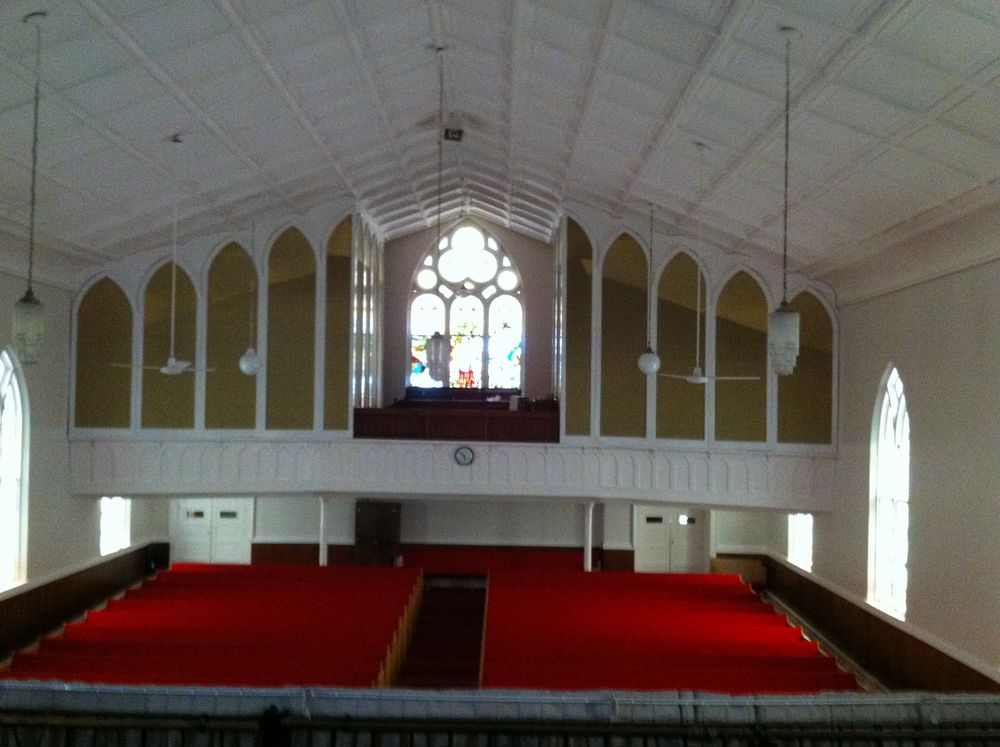
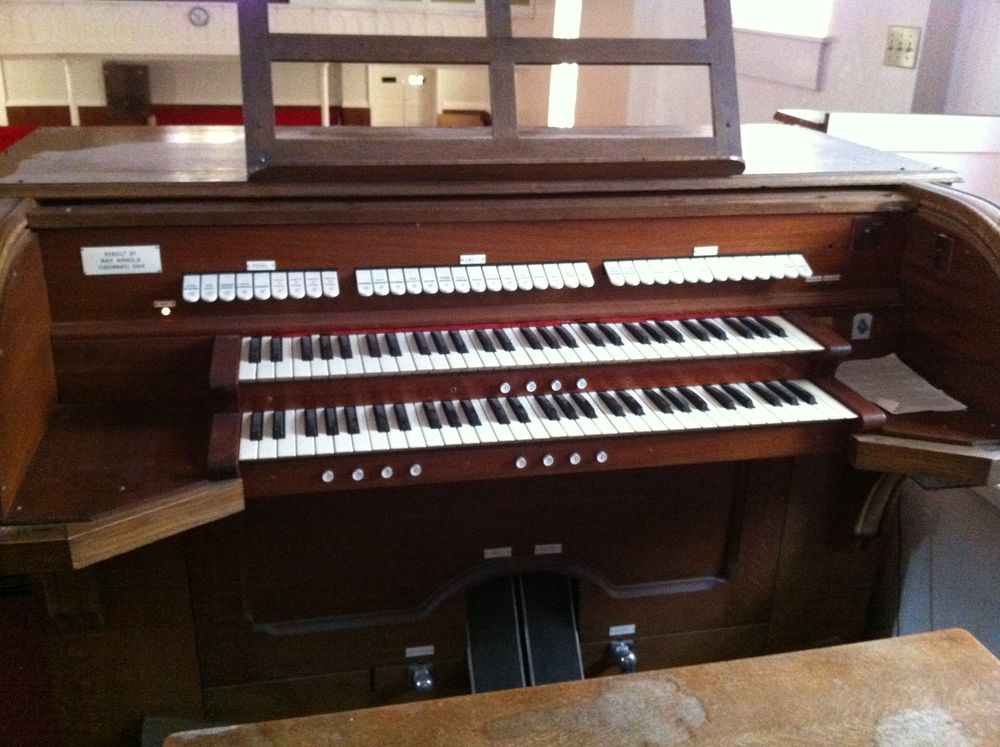
I was the organist at Second Baptist Church during my senior year in high school from 1979-1980. I used to have a copy of a repair proposal from Bunn=Minnick Co. which was lost years ago in my many moves. When I left the church to move to Dallas in August of 1980, the organ was still playing. The pipes were located in the rear balcony on both sides behind the screens. The large 16' open wood pipes were on the floor running horizontally across the balcony. I took the two pictures when I visited the church in 2015. They graciously let me go up to the console but the organ was unplayable. I seem to remember they said the blower was not working. That was of course an issue once back when I was organist there. I spent many wonderful hours at that organ. It was located a few blocks from where I lived. Reverend Walton was a wonderful minister, very encouraging.
J. A. Hefner on January 1st, 2024:
It isn't immediately clear if the Pilcher organ is still there - I tried reaching out a few times and never heard back. It could be - a couple keyboard instruments/consoles can be seen in church photos/livestream videos, including a music rack [the type that would be on an organ console] in the chancel loft, and what looks to be a console instrument to the right of the chancel/stage area.
The console of the 1960 organ may have been installed in the chancel choir loft, with the pipes elsewhere in the sanctuary. It also appears that the 1960 organ replaced an earlier organ of unknown origin...
An undated photo shows former pastor W. S. Smith and his wife [per granddaughter Marilyn Hoytt] in the chancel, with a 17-stop, 2-manual, attached-console pipe organ visible, surrounded by chairs for the choir.
This couldn't be the 1960 Pilcher from Central Methodist, as that had 22 stops [and for a 1910s electro-pneumatic Pilcher, shouldn't they be switch-tabs?]. The facade pipes here are stencilled unlike the Pilcher ones, which appear plain in Central Methodist photos.
The facade's middle pipe-flat shows 7 pipes standing out from the rest, in a manner like the 5-pipe distinct flat Hinners often had. To me, the instrument looks rather like an 1890s-1910s tracker organ, though only part of it is visible.
The loft organ, showing console and facade pipes - https://www.facebook.com/photo/?fbid=1163871593949056&set=a.568187372018026 - possibly in the same timeframe as the others linked below
"1930s or 40s" mock-wedding showing the loft organ, console closed - https://www.facebook.com/photo/?fbid=1163871270615755&set=a.568187372018026
Partly visible again - https://www.facebook.com/photo/?fbid=1163871710615711&set=a.568187372018026
For context of the first image, "I am # 16. Marilyn Pryce Hoytt. Granddaughter of Rev. & Mrs. W.S. Smith, former pastor & wife" - https://www.facebook.com/photo/?fbid=1163871613949054&set=a.568187372018026
Database Manager on July 19th, 2017:
Updated by J. A. Hefner, listing this web site as a source of information: http://www.savetheorgan.org/kbase/opus_lists/pilcher.txt.
The Pilcher opus list states this is opus 829, 22 stops.
Database Manager on July 14th, 2017:
This entry describes a new home for an organ that was relocated without either tonal or mechanical changes.
Identified by J. A. Hefner, citing information from this publication: Referenced in "A Brief History of Central United Methodist Church, 1805-1980" by Harry C. Laybourne, 1982.
This instrument was originally installed in 1914 at Central Methodist. It was removed and sold to Second Baptist in 1960, when Central had a new Möller installed.
Related Instrument Entries: Henry Pilcher's Sons (Opus 829, 1914)
Something missing or not quite correct?Add NoteorAdd WebpageorAdd Cross ReferenceorSuggest an Edit