E. & G. G. Hook
Opus 322, 1863
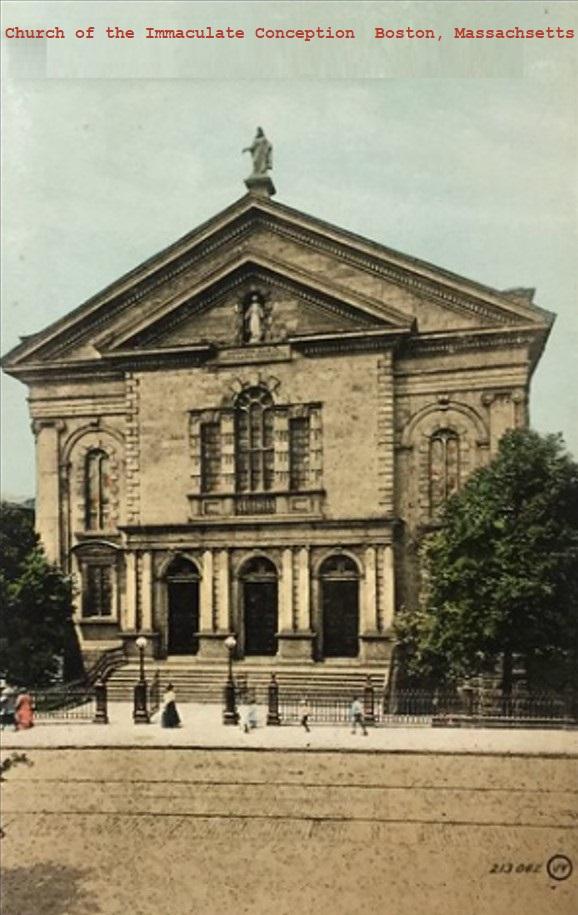
Immaculate Conception Roman Catholic Church
Harrison Avenue
Boston, MA, US
Something not quite correct?Suggest an Edit
🤝 Instrument entries in Massachusetts sponsored by:
We are grateful for the generous support of our sponsors, who make it possible for us to continue our mission of preserving and promoting the rich history of pipe organs across the globe.

IMAGES


Something missing or not quite correct?Add ImageorSuggest an Edit
STOPLISTS
Something missing or not quite correct?Add Stoplist
CONSOLES
Builder: Unknown
Position: Unknown
Design: Unknown
Pedalboard Type: Unknown
Features:
3 Manuals 47 StopsMechanical (Unknown) Key ActionMechanical Stop ActionStop Layout: Unknown
Expression Type: Unknown
Combination Action: Unknown
Control System: Unknown or N/A
Something missing or not quite correct?Add ConsoleorSuggest an Edit
DETAILS
This instrument is: Not Extant and Not Playable in this location
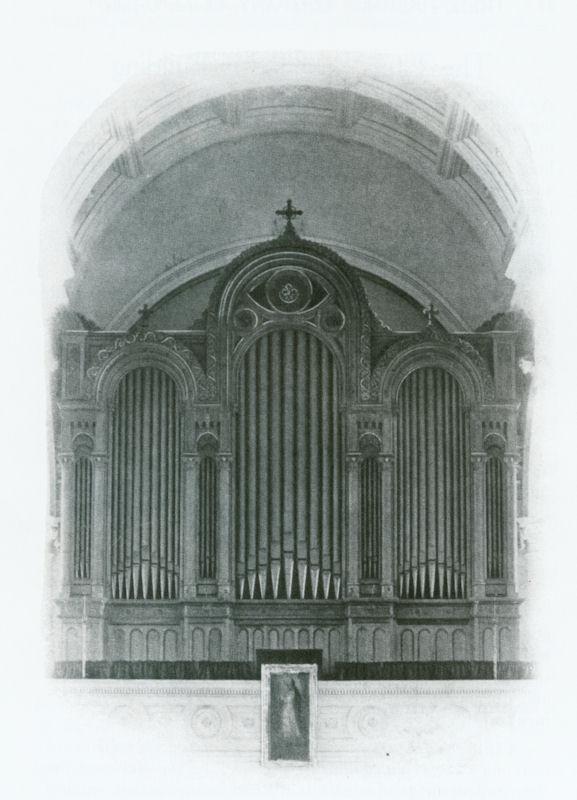
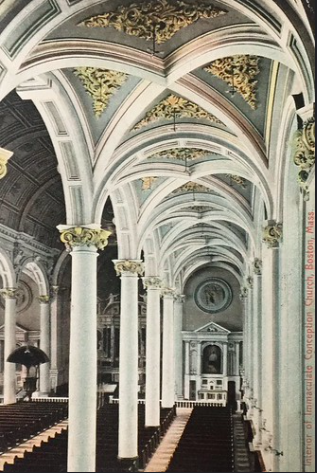
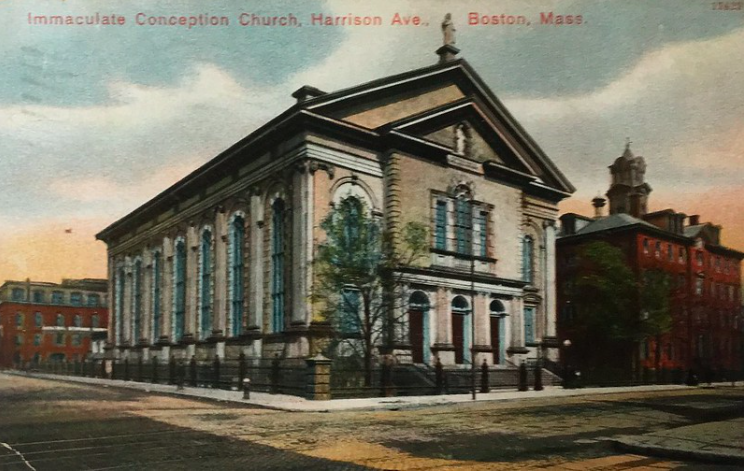
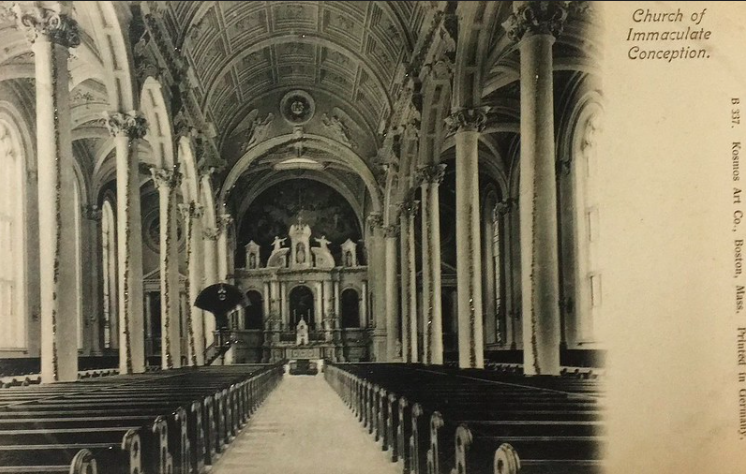
The case, designed by the builder of the church, Patrick Keeley, was not built by the Hooks, but by a separate firm. Typical for non-organbuilder constructed cases, the case was nailed, where builders would always construct their cases with screws. The facades pipes were in a tin-colored leaf, likely Palladian leaf with black ornamentation about the mouths. This can be seen in historic stereo slides of the interior. The pipes were redecorated with an opaque gold glaze. The Great action and its couplers were fitted with a Barker machine assist- likely the first for Hook, and the console, typical for large Catholic churches, was detached and reversed so the organist faced the altar. The organ had two pressures, 3" for the manuals, 3 1/2" for the Barker machine and Pedal division. The organ was built during a period of adversity for the Hook firm, with almost the entirety of the staff away at War, and the remaining group, probably about 15 or so older men, disabled, or immigrants managed to construct this monumental organ at a time that there were constant material shortages.
The Swell had a double set of shades operated by a hitchdown pedal, and like the Cathedral of Holy Cross built a decade later, was so heavy it practically required the organist to stand on the pedal to open it. The famous organist John Willcox was the church's organist at the time of the organ's opening. He had worked with the Hooks on and off as an advisor on tonal affairs, and the forward-looking disposition of this major work bears the stamp of his input, employing a wide variety of color and pipe forms, with a sophisticated terracing of dynamics between the various stops.
From the outset, the organ was unexpectedly mild in the spacious acoustic of the church, possibly partly due to the density of the facade. This was addressed in the 1902 rebuild with the addition of the high-pressure Solo and scale enlargement of the main Great Diapason. At some point before 1902, the Pedal was enlarged with the needed addition of the Bourdon 32' and stopped Flute 8'. Each of the three manual chests had been prepared with an empty slider, and that of the Choir at least was intended for a Mixture. Just seven years after the organ was opened, the large and unusual Cymbale was installed on the Great, but by William Johnson of Westfield. This would have been a major slap in the face to the Hooks for whom this was a major commission in the city of Boston and whose shop was practically around the corner. The story behind this is lost to us, but surely involved some kind of intrigue. The city of Boston is unique in having large Cymbales on three of its most important 19th-century instruments: Immaculate, Holy Cross, and Mission Church, and while the function of each was surely intended to be similar, the composition of each was different. While the Great Stopt Diapason would not have been unusual in a stoplist of this era, we know this stop was actually a Doppel Flute--introduced this same year in the Walcker installed in the Boston Music Hall and obviously a last-minute upgrade. Unfortunately, this was replaced in 1902 with the Mezzo Diapason.
Database Manager on November 4th, 2005:
Updated through online information from Sean O'Donnell.
Database Manager on October 30th, 2004:
Rebuilt and electrified by Hook & Hastings in 1902 as Op. 1959, (4-47).
Webpage Links: JUC Boston: Elias and George Greenleaf Hook Organ
Related Instrument Entries: Hook-Hastings Co. (Opus 1959, 1902)
Something missing or not quite correct?Add NoteorAdd WebpageorAdd Cross ReferenceorSuggest an Edit