Relocated byOwner
ca. 1880
Originally George [Geo.] Jardine (1842)
The Congregational Church Society of Christ (1822)
Sanctuary; rear gallery
174 Main Street
Worcester, NY, US
5 Ranks - 1 Physical Divisions
Something not quite correct?Suggest an Edit
🤝 Instrument entries in New York sponsored by:
We are grateful for the generous support of our sponsors, who make it possible for us to continue our mission of preserving and promoting the rich history of pipe organs across the globe.

IMAGES

Something missing or not quite correct?Add ImageorSuggest an Edit
STOPLISTS
No stoplist details are available. If you have stoplists, please consider sharing them with us.
Something missing?Add Stoplist
CONSOLES
Builder: George [Geo.] Jardine
Position: Keydesk Attached
Design: Traditional With a Keyboard Cover That Can Be Lifted To Form a Music Rack
Pedalboard Type: Flat Straight
Features:
1 Manuals (60 Notes)12 Note Pedal1 Divisions3 Stops6 RegistersMechanical (Balanced Tracker) Key ActionMechanical Stop ActionCombination Trundle(s)Stop Layout: Drawknobs in Horizontal Rows on Flat Jambs
Expression Type: Trigger/Hitch-Down Expression
Combination Action: Fixed Mechanical
Control System: Unknown or N/A
Something missing or not quite correct?Add ConsoleorSuggest an Edit
DETAILS
This instrument is: Not Extant and Not Playable in this location
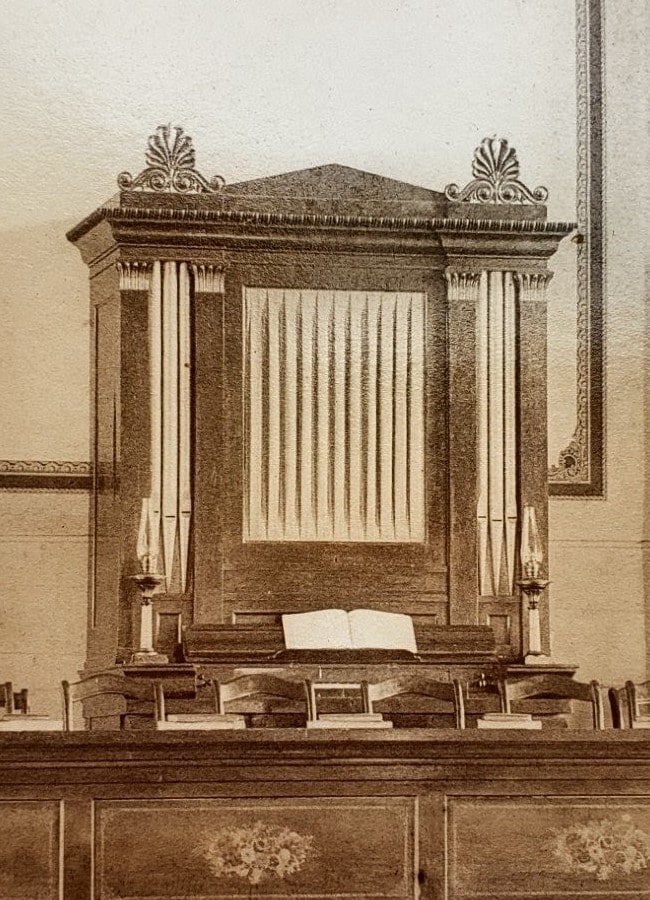
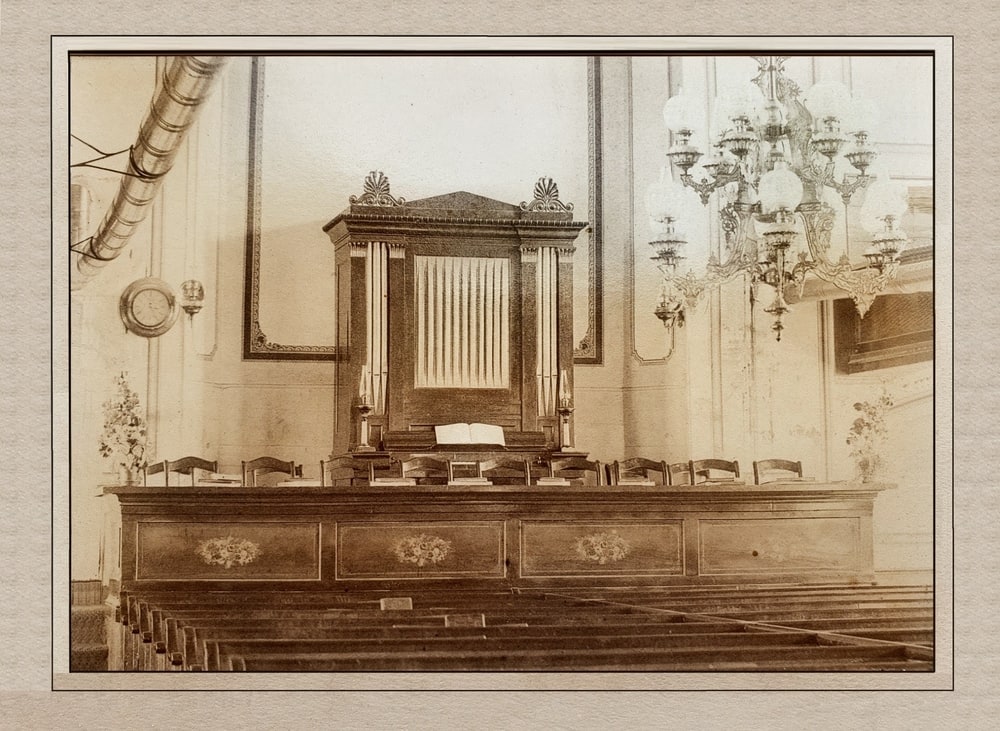
Some time around 1880 the congregation sent a group to Duanesburg, about 40 miles distant, for the purpose of attending the auction of the contents of the Catherine Duane Livingston mansion (Featherstonehaugh) by her descendants, which included a fine chamber organ. Catherine died in 1852 with her property passing through her children and grandchildren. The church's intention was to bid on the organ with the purpose of purchasing it and bringing it home. We don't know what the final bid was, nor how many parties may have been bidding against them. It is believed that the organ may have originally been in a NYC residence, or it may have been original to this grand home, built ca. 1812. There is a photo of the organ, likely from the 1880s, showing the organ in-situ in the church, with its top pediment and carved decorations intact, making an already tall organ, grandly tall. The Worcester church was town down and replaced with a modern and less imposing Akron-style church in 1892. An early postcard of the organ in the new church without its top decorations is dated either 1903, 1908, or 1909. The postmark was incomplete making the exact date unclear. The pleated center screen was redone for the new location under a large window, apparently in a different color, and not nearly as nicely pleated. The organ remained in the Worcester church until it was replaced with an Estey two-manual electro-pneumatic organ, and the Jardine was either sold or given to the Presbyterian Church in Middlefield Center, about 12 miles northwest as the crow flies. The organ remained in Middlefield until that church closed in the late 1960s to become a residence, and Sidney Chase of Worcester rescued the organ and brought it to its shop. It remained there for several years before it was sold through the Organ Clearing House to a low-power classical music station in Seattle. It was on the market again by 1982 for an inflated price. It has moved four times since, most recently in 2022 when it was acquired by S.L. Huntington & Co. for relocation to another church in upstate New York, yet to be restored and installed as of this writing in 2026. Except for replacement of the Op. Diap. with a second-hand Gamba, either when it was moved to Middlefield or Seattle, the installation of an electric blower, slide tuners, and minor repairs, the organ is otherwise original. It is very likely George Jardine's oldest extant organ. With its moving history across nine homes, it is a miracle survival, and could have perished at any time.
Scot Huntington on September 18th, 2021:
The accompanying photo is the oldest known image of the organ and shows the interior of the original 1822 building. The Greek embellishments atop the case add considerably to the impression of size and the crisp pleats in the center screen are quite clear. It is unfortunate the top decorations were discarded when the organ was moved, and were probably considered too old-fashioned for modern taste. The 1822 building was more spacious and lofty than the 1892 building, and likely had better acoustics. While the early photos of the instrument show the capitals to be gilded, photos of the case since 1970 show them to match the woodwork.
Scot Huntington on September 8th, 2021:
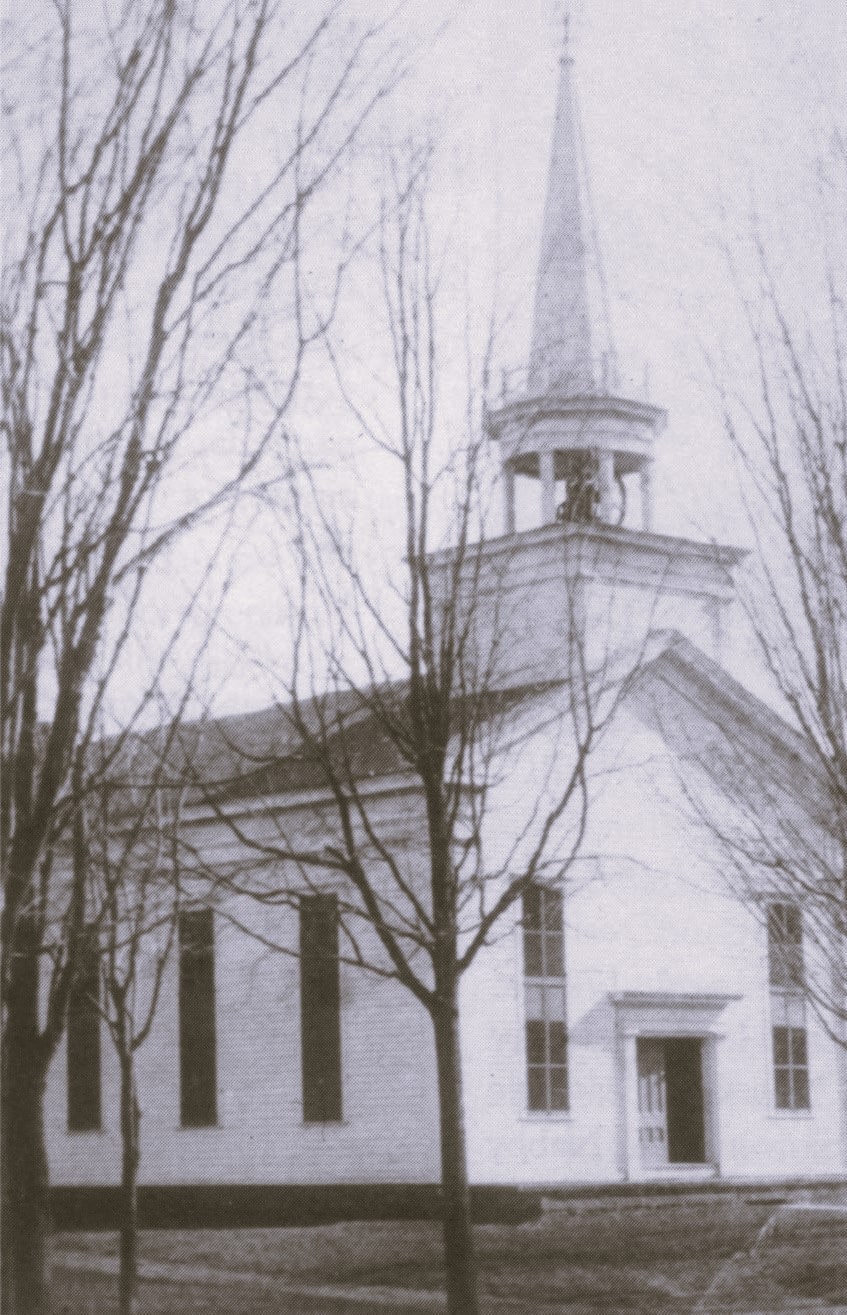
This elegant parlor organ is well-travelled, at present count in its seventh home (2021). The Congregational church of Worcester built its first structure in 1822, remodeled it in 1865, and replaced it with a new building in 1892, erected adjacent to it. At that time, the 1822 building was demolished and the parsonage erected on the site. The church history suggests the organ was acquired at an as-yet unknown date in the 19th-century, from an auction of the contents of the Duane mansion in nearby Duanesburg. It is this connection to which the organ's source is credited.
Supposedly, there is a photo of the organ in this earlier building prior to its move to the new structure in 1892 (itself documented in 1909 images). In 1917, the congregation dissolved its association with the Congregationalists and joined the Presbyterian denomination. It is highly likely, given the organ's simple construction and close proximity, that church people moved the organ from one building to the next. In 1929, the organ was replaced by a larger Estey electro-pneumatic instrument and the organ was moved, again by an unknown individual(s), to the Presbyterian Church in nearby Middlefield, New York. When that church closed in 1965, the organ was sold to a classical music radio station in Seattle, then to a private residence in Oregon in the late 70s-early 80s, then to its present home, Providence Presbyterian Church, in Powhatan, Virginia in 1990.
Related Instrument Entries: George [Geo.] Jardine (1842) , Relocated byOwner (1892) , Relocated byLawrence Trupiano (1990) , Relocated byBond Pipe Organs Inc. (1980) , Relocated w/ modifications byBond Pipe Organs Inc. (1980s) , Relocated byRandall J. McCarty (ca. 1970-72) , Relocated byRobert S. Rowland (1937) , Relocated byChase Organ Co. (Sidney Chase) (ca. 1968) , Relocated byS. L. Huntington & Co. (2012)
Something missing or not quite correct?Add NoteorAdd WebpageorAdd Cross ReferenceorSuggest an Edit