🤝 Instrument entries in Pennsylvania sponsored by:
We are grateful for the generous support of our sponsors, who make it possible for us to continue our mission of preserving and promoting the rich history of pipe organs across the globe.


IMAGES
Something missing or not quite correct?Add ImageorSuggest an Edit
STOPLISTS
No stoplist details are available. If you have stoplists, please consider sharing them with us.
Something missing?Add Stoplist
CONSOLES
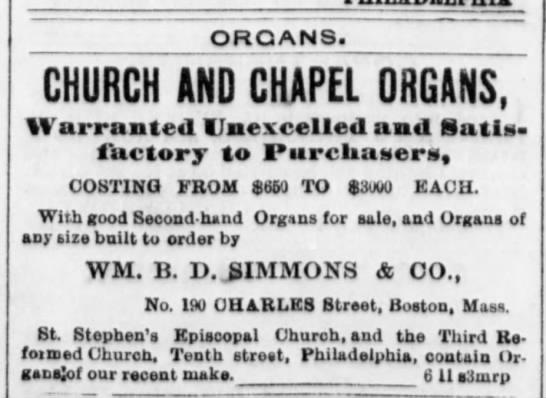
Builder: Wm. B.D. Simmons
Position: Keydesk Attached
Design: Traditional With a Keyboard Cover That Can Be Lifted To Form a Music Rack
Pedalboard Type: Unknown
Features:
3 Manuals Mechanical (Unknown) Key ActionMechanical Stop ActionStop Layout: Drawknobs in Horizontal Rows on Terraced/Stepped Jambs
Expression Type: Balanced Expression Shoes/Pedals (Details Unknown)
Combination Action: Unknown
Control System: Unknown or N/A
Something missing or not quite correct?Add ConsoleorSuggest an Edit
DETAILS
This instrument is: Not Extant and Not Playable in this location
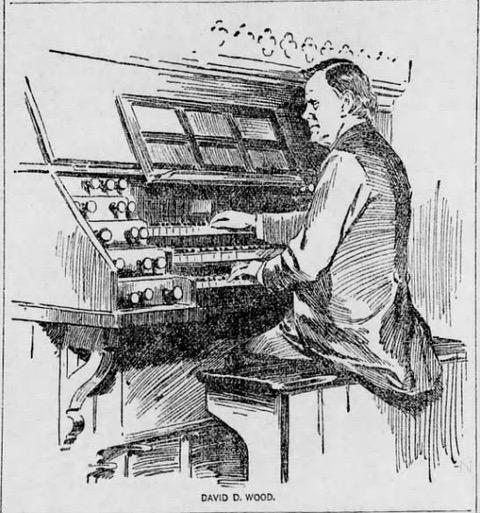
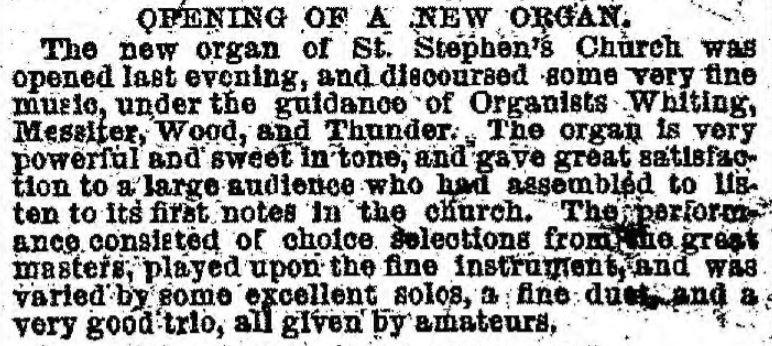
A brief description of the 1864 W. B. D. Simmons Organ of St. Stephen’s Episcopal Church, Philadelphia written by Harry Rumrill (1867-1951), a former David D. Wood (1838-1910) student who had lessons on this instrument. Wood probably had a hand in the design of this instrument. Wood was the church’s organist for the entire life of this organ. It was replaced in 1907 by a C.S. Haskell. The following is from Rumrill’s c.1942 unpublished biography of Wood.
“The old organ in St. Stephen' s Church was, like others mentioned above, cased in harmony with the church interior and was otherwise an instrument worthy of the ability of the organist (David D Wood) who graced its console for almost half a century. It was built by Simmons and McIntyre, a Boston firm, whose reputation could have rested on this instrument alone. Among the beautifully voiced stops that imparted high quality to their work was a "Tenoroon Hautbois" on the upper manual, and on the lowest manual another read stop, the “Corno di Bassetto”, much favored by Mr. Wood, also a string-toned register, the “Keraulophon” which had been invented by the eminent organ builders Gray and Davison of London, about twenty years before. Its inclusion in St. Stephen's organ evidenced the progress in organ building then taking place in our country. Many of the stop combinations were rich, and the full organ ensemble very brilliant; Mr. Wood having the rare ability to discern the many hundreds of varieties of tone at command in a good organ - a marked contrast to the general character of organ tone where the player is content to use but few of the possible combinations that lie dormant in his instrument. “
Paul R. Marchesano on January 5th, 2022:
In May 1864 the Committee reported it adopted the plans submitted by a “Mr. Simon of Boston” (William Benjamin Dearborn Simmons) for a pipe organ costing $4000. The Committee recommended that the old organ be repaired and purchased for the Burd Orphan Asylum’s chapel. The organ was of 3 manuals with a "full pedal-board". Replaced in 1907 by a large, 4 manual, electropneumatic action C.S. Haskell organ.
Something missing or not quite correct?Add NoteorAdd WebpageorAdd Cross ReferenceorSuggest an Edit