Hillgreen, Lane & Co.
Opus No. 89, 1903
First United Methodist [Episcopal] Church
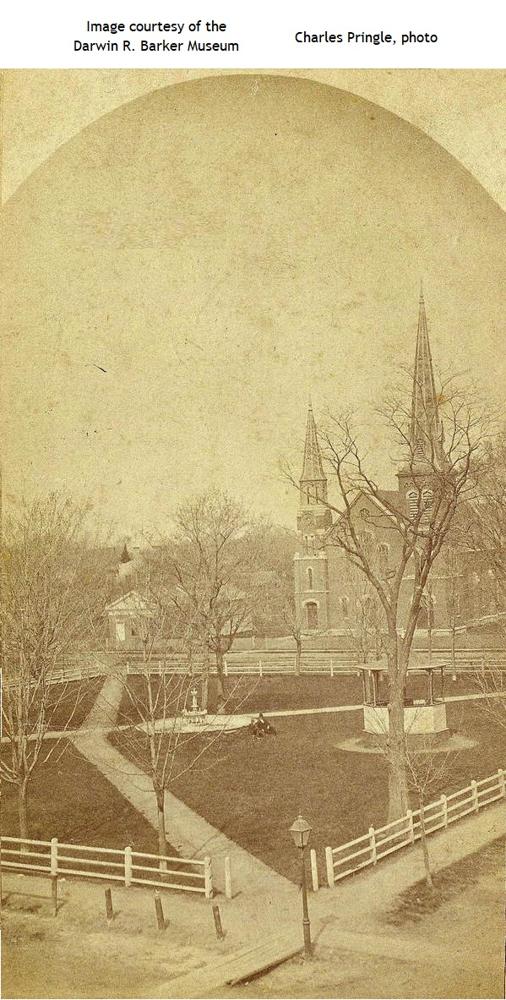
1868 building
25 Church Street
Fredonia, NY, US
15 Ranks
Something not quite correct?Suggest an Edit
🤝 Instrument entries in New York sponsored by:
We are grateful for the generous support of our sponsors, who make it possible for us to continue our mission of preserving and promoting the rich history of pipe organs across the globe.

IMAGES
Something missing or not quite correct?Add ImageorSuggest an Edit
STOPLISTS
Something missing or not quite correct?Add Stoplist
CONSOLES
Builder: Hillgreen, Lane & Co.
Position: Keydesk Attached
Design: Traditional With a Keyboard Cover That Can Be Lifted To Form a Music Rack
Pedalboard Type: Concave Radiating (Details Unknown)
Features:
2 Manuals (61 Notes)30 Note Pedal3 Divisions16 Stops22 RegistersTubular Pneumatic (Unknown) Key ActionTubular Pneumatic (Unknown) Stop ActionCrescendoCoupler Trundle(s)Stop Layout: Drawknobs in Horizontal Rows on Terraced/Stepped Jambs
Expression Type: Balanced Expression Shoes/Pedals (Details Unknown)
Combination Action: Fixed Mechanical
Control System: Unknown or N/A
Something missing or not quite correct?Add ConsoleorSuggest an Edit
DETAILS
This instrument is: Not Extant and Not Playable in this location
The favorable outcome of this organ was instrumental in the choice of Hillgreen, Lane to build the new 1909 organ in the chapel/assembly hall of the nearby State Normal School, a sprawling structure with classrooms, gymnasium, lecture rooms, dining hall, and residential rooms in one building.
Scot Huntington on March 19th, 2022:
The Hilgreen Lane instrument was installed in the congregation's third building, a large two-towered brick edifice (1868) facing the town square and next door to the Baptist church which was itself the founding entity of the Women's Christian Temperance Union (WCTU). This building was damaged heavily enough by fire ca. 1923 (the roof, attic, and towers were gutted) it was demolished and replaced with the present, smaller structure on the same lot. This coincides with the installation of the Tellers-Kent in 1924, reusing what was salvageable from the Hillgreen, Lane. The Tellers also used ventil chests.
Scot Huntington on March 19th, 2022:
The contract for a new organ was signed on Dec. 11, 1903, for an instrument to be installed by May 1, 1904. An organ of this size was a bargain at $2,100.00. The instrument had tubular-pneumatic action with a traditional terraced-jamb keydesk. The organ was provided with a Ross water motor, (contract addendum) and a Bellows Signal, suggesting either that the organ could be powered by water or by human power, or because it was a hand-written addition in the contract, superceded the original intention for hand pumping- the signal for which could have now been superfluous. The contract stated Hillgreen had use of the building for 10 days after completion of the installation, for the purposes of regulating and tuning.
The organ was rebuilt and electrified by Tellers-Kent as their opus 301 in 1924, and rebuilt and enlarged again by the Tellers Organ Co. as opus 614 in 1937. The 1937 instrument was replaced by a new Schlicker 3-man. tracker in 1971.
Related Instrument Entries: Tellers-Kent Organ Co. (1924)
Something missing or not quite correct?Add NoteorAdd WebpageorAdd Cross ReferenceorSuggest an Edit