Wm. Johnson & Son
Opus 778, 1892
Sacred Heart Roman Catholic Church
13 Wolcott Street
Waterbury, CT, US
36 Ranks - 2,072 Pipes - 4 Physical Divisions
Historic Organ Citation Awardee
EXPLORE IMAGESVIEW STOPLISTSomething not quite correct?Suggest an Edit
🤝 Instrument entries in Connecticut sponsored by:
We are grateful for the generous support of our sponsors, who make it possible for us to continue our mission of preserving and promoting the rich history of pipe organs across the globe.

IMAGES
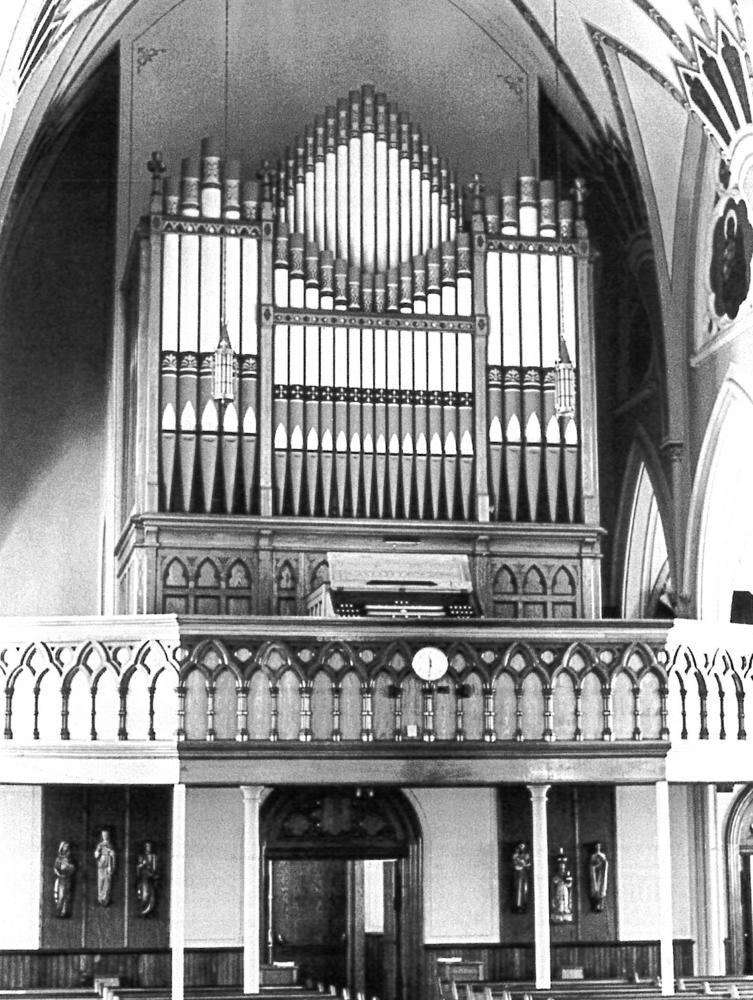
Something missing or not quite correct?Add ImageorSuggest an Edit
STOPLISTS
Something missing or not quite correct?Add Stoplist
CONSOLES
Builder: Wm. Johnson & Son
Position: Keydesk Attached
Design: Traditional With a Keyboard Cover That Can Be Lifted To Form a Music Rack
Pedalboard Type: Flat Straight
Features:
3 Manuals (61 Notes)30 Note Pedal4 Divisions31 Stops32 RegistersMechanical With Pneumatic Assists Key ActionMechanical Stop ActionCombination Trundle(s)Stop Layout: Drawknobs in Horizontal Rows on Terraced/Stepped Jambs
Expression Type: Balanced Expression Shoes/Pedals (Not Meeting AGO Standards)
Combination Action: Fixed Mechanical
Control System: Unknown or N/A
Something missing or not quite correct?Add ConsoleorSuggest an Edit
DETAILS
Exhibited in the 1994 OHS convention(s)
This instrument is: Not ExtantandNot Playable in this location
The pitch as measured at disassembly was A438 at 72 degrees, the main reservoir pressure (static) feeding the pedal and Barker was 4" and the manual pressure was 3 1/4", slightly higher than Johnson's usual standard 3".
There is a large arch behind the organ which separates the church gallery from the large tower space behind. The Choir division with a narrow windchest sits inside the thick masonry arch, while the Pedal division and main reservoir (originally with feeders) is in the large tower room behind, acoustically somewhat separated from the sanctuary and main organ. This could account for the higher than usual Pedal pressure and enormous scale of the Pedal Diapason.
Scot Huntington on March 30th, 2024:
There has been some debate whether the Bellows Signal is original--it would have been superfluous on an instrument which had a water motor from the beginning and without the ability for hand pumping. It has long been connected to an electrical switch for turning on the first Spencer blower added in the teens or 20s, and may have been a control that was added for that purpose. The present blower is a 1950s Spencer with a sealed Allis motor, added second hand by Hamar in the late 1980s after the original blower failed. The large water motor is still installed in the basement and there are plans to salvage it along with the organ, but the feeder bellows were removed with the installation of the first blower.
Scot Huntington on March 30th, 2024:
The Barker machine was sub-contracted to Ira Bassett, who made pneumatic assistance machines for the trade. It is an inflate-to-play system--a technology that was considered old-fashioned in America by the time of the organ's construction in 1892. Following the Hook company's development of the exhaust-to-play system in the late 1870s-early 80s, their improved form of Barker technology quickly became the default system in the work of American builders thereafter, until the advent of non-mechanical action systems.
Scot Huntington on March 30th, 2024:
In 2019 a consolidation of RC churches in Waterbury closed five churches and the Sacred Heart congregation was merged with that of St. Anne's Basilica. The old church was allowed to remain open as a temporary sanctuary for use by the local Spanish congregation as a location for weddings, funerals, and festivals, pending the sale and transfer of the building. The building, large rectory, and attached school have been bought by the city of Waterbury for city offices, with closing and transfer of ownership by the end of April 2024. The Sacred Heart building is protected for 10 years, but not beyond, and the long-term future of this historic complex is in peril. The building recently closed to further religious activity and the process of salvaging the religious artifacts has begun. However, a new home for this large and imposing organ has not been identified and previous attempts to relocate it beginning in 2019 have not come to fruition. Consequently, under the direction of Cathedral organist Ezekiel Menendez, protection of the instrument has been a priority, and dismantling of the instrument began on March 18, 2024. It is being removed to a diocese storage facility along with the church's sacred artifacts and windows. The work of dismantling is being handled by the globally respected Grenzing company from Spain and will be completed by April 5, 2024.
Database Manager on March 4th, 2018:
Updated by Damian M. Schloming, who has heard or played the organ. I just know the Swell has a Dolcissimo. When I first submitted the stoplist, I included that stop. When I first saw it put up online, the stoplist was accurate. Now, it appears that the Dolcissimo has been taken out.
Database Manager on October 30th, 2004:
Status Note: There 1994
Database Manager on October 30th, 2004:
Barker machine. Restored R. Hamar 1974-1982. Historic Organs Recital 18 Jun 1989.
Something missing or not quite correct?Add NoteorAdd WebpageorAdd Cross ReferenceorSuggest an Edit