S. R. Warren & Sons
1882
Trinity Anglican Church
115 Charlotte Street
Saint John, NB, CA
38 Ranks - 2,068 Pipes
Something not quite correct?Suggest an Edit
IMAGES
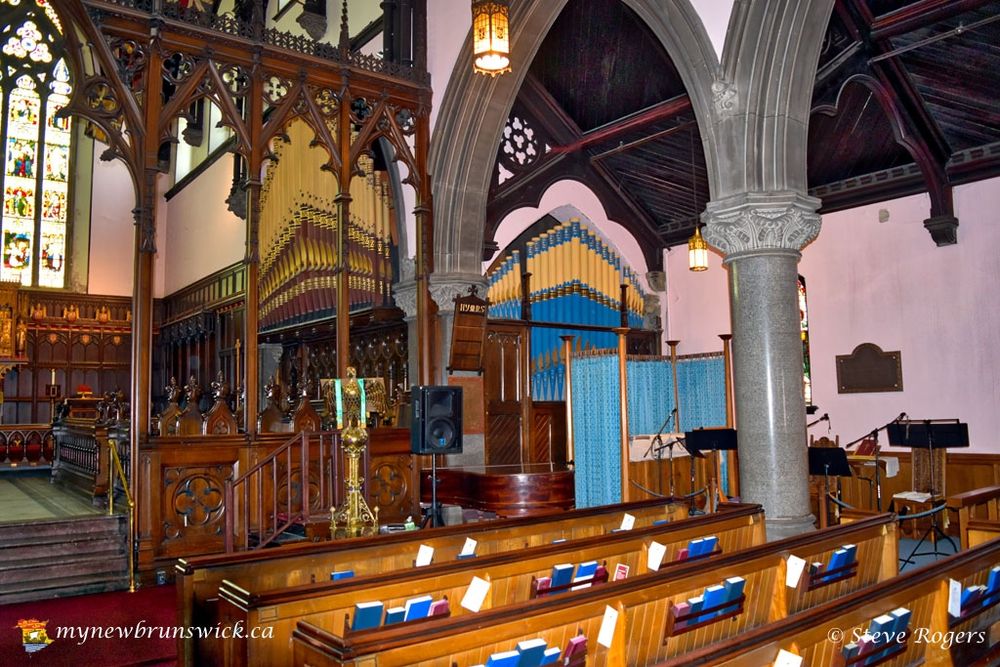
Something missing or not quite correct?Add ImageorSuggest an Edit
STOPLISTS
| Great Organ (II) | ||
| 16' | Double Diapason | 58 |
| 8' | Open Diapason | 58 |
| 8' | Gamba | 58 |
| 8' | Doppel Flute | 58 |
| 8' | Dolce | 58 |
| 4' | Principal | 58 |
| 4' | Flute d'Amour | 58 |
| 2 2⁄3' | Twelfth | 58 |
| 2' | Fifteenth | 58 |
| III | Mixture | 174 |
| II | Mixture | 116 |
| 8' | Trumpet | 58 |
| 4' | Clarion | 58 |
| 8' | Swell Organ to Great Organ |
| Swell Organ (III - Expressive) | ||
| 16' | Bourdon | 58 |
| 8' | Open Diapason | 58 |
| 8' | Viol di Gamba | 58 |
| 8' | Stopped Diapason | 58 |
| 4' | Octave | 58 |
| 4' | Traverse Flute | 58 |
| 2' | Fifteenth | 58 |
| III | Mixture | 174 |
| 8' | Cornopean | 58 |
| 8' | Oboe | 58 |
| Choir Organ | ||
| 8' | Geigen Principal | 58 |
| 8' | Dulciana | 58 |
| 8' | Melodia | 58 |
| 4' | Harmonic Flute | 58 |
| 2' | Piccolo | 58 |
| 8' | Orchestral Clarinet | 46 |
| 8' | Swell Organ to Choir Organ |
| Pedal Organ | ||
| 16' | Double Open | 27 |
| 16' | Bourdon | 27 |
| 8' | Violoncello | 27 |
| 16' | Contra Posaunne [sic] | 27 |
| 8' | Swell Organ to Pedal Organ | |
| 8' | Great Organ to Pedal Organ | |
| 8' | Choir Organ to Pedal Organ |
Bellows signal; Tremolo to Swell Organ; Forte/Mezzo/Piano Combination pedals to Great Organ; Forte/Piano Combination pedals to Swell Organ; Small [sic, Swell?] Pedal; A Choir to Great coupler is not included in source
Originally Written/Published: January 23, 1882
Something missing or not quite correct?Add StoplistorSuggest an Edit
CONSOLES
Features:
3 Manuals (58 Notes)27 Note Pedal32 StopsMechanical (Unknown) Key ActionMechanical Stop ActionCombination Trundle(s)Stop Layout: Unknown
Expression Type: Balanced Expression Shoes/Pedals (Details Unknown)
Combination Action: Unknown
Control System: Unknown or N/A
Something missing or not quite correct?Add ConsoleorSuggest an Edit
DETAILS
This instrument is: Not Extant and Not Playable in this location
From The Daily Telegraph (Saint John, NB, January 23, 1882): "The magnificent new organ recently put up in Trinity Church was used for the first time at public worship yesterday. It was manufactured by S. R. Warren & Son, of Toronto (formerly of Montreal), and is one of the largest organs in the Maritime provinces, and the largest in this city, the number of pipes being in excess of those of the Cathedral or St. Andrew's Church organs. So far as appearance goes, it is entirely in keeping with the beautiful interior of the church, and is placed in the chamber provided for the organ in the plan of the church. There are two fronts, the principal one facing the chancel and the other -- the smaller -- the nave. The pipes, which are painted a crimson and buff color, traced with gold, fill the arches so thoroughly, as to almost hide them from view. The style of decoration is new in St. John, and is certainly very beautiful, and indicates thorough and intelligent workmanship. There is nothing gaudy about the design or coloring, both of which harmonize with the surroundings. The woodwork of the organ matches the other woodwork about the chancel. Professor Porter, who was agreed upon by the Church Wardens and the manufacturer to pronounce judgment on the organ, tested the instrument thoroughly on Saturday, and pronounced himself greatly pleased with it. He said to a reporter: 'The work has been done quite in accordance with the specification. The mechanism is clean and tone as near perfect as possible. The pipe work has all been well made, and is beautifully voiced.' A great addition to the completeness of the organ was made at the suggestion of Prof. Devine, the organist of the church. It is a reversible, pedal for coupling the great organ to the pedal organ, and it is a most ingenious arrangement. By simply pressing the foot on the coupler, pedal to great is crown on and by repeating the same motion it is thrown back. The keys and pedals are conveniently placed, and are extremely easy in their action, the touch being no heavier than on a piano. The compass of manuals, of which there are three, sets it from C.C. to A3 -- 58 notes; that of pedals from C.C.C. 16 feet to D. The total number of pipes is 2,200, or 300 more than are in the Cathedral organ. The great organ contains 13 stops, 2 of which are reeds. The swell organ contains 10 stops, 2 of which are reeds. The choir organ contains 6 stops, 1 of which are reeds. The pedal organ contains 4 stops, 1 of which is a very powerful reed, and was put in by the builder to make the organ complete and also as a speculation."
Related Instrument Entries: Casavant Frères Ltée. (Opus 262, 1906)
Something missing or not quite correct?Add NoteorAdd WebpageorAdd Cross ReferenceorSuggest an Edit