Jean Renaud / Maison Renaud-Ménoret
1994
Originally Louis-Alexandre Clicquot (1756)
Église Saint-Roch
Gallery
296 Rue Saint-Honoré
Paris, FR
63 Ranks - 2,963 Pipes - 4 Physical Divisions
EXPLORE IMAGESVIEW STOPLISTSomething not quite correct?Suggest an Edit
IMAGES
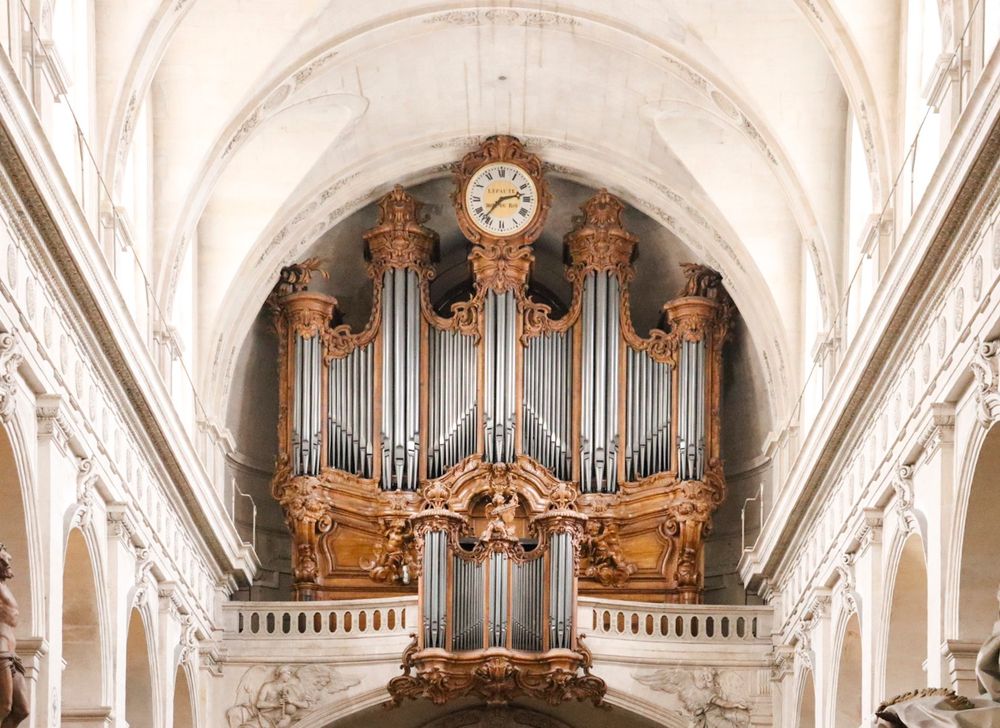
Something missing or not quite correct?Add ImageorSuggest an Edit
STOPLISTS
| Positif de dos (I) | ||
| 8' | Montre | 54 |
| 8' | Bourdon | 54 |
| 8' | Flûte harmonique | 37 |
| 8' | Gambe | 54 |
| 8' | Voix céleste | 54 |
| 4' | Prestant | 54 |
| 4' | Dulciana | 54 |
| 2 2⁄3' | Nazard | 54 |
| 2' | Doublette | 54 |
| 1 3⁄5' | Tierce | 54 |
| V | Cornet | 150 |
| II | Grande Fourniture | 108 |
| IV | Fourniture | 216 |
| III | Cymbale | 162 |
| 8' | Trompette | 54 |
| 8' | Cromorne | 54 |
| 8' | Hautbois | 37 |
| 4' | Clairon | 54 |
| Grand-Orgue (II) | ||
| 16' | Montre | 54 |
| 16' | Bourdon | 54 |
| 16' | Corni dolci | 30 |
| 8' | Montre | 54 |
| 8' | Bourdon | 54 |
| 8' | 1ère flûte harmonique | 54 |
| 8' | 2ème flûte harmonique | 54 |
| 8' | Salicional | 54 |
| 4' | Prestant | 54 |
| 4' | Gambe | 54 |
| 2' | Octavin | 54 |
| 8' | Bombarde to Grand-Orgue | |
| 8' | Positif de dos to Grand-Orgue | |
| 8' | Récit expressif to Grand-Orgue |
| Bombarde (III) | ||
| 16' | Bombarde | 54 |
| 8' | 1ère Trompette | 54 |
| 8' | 2ème Trompette | 54 |
| 4' | Clairon | 54 |
| 2-4' | Clairon | 54 |
| Récit expressif (IV - Expressive) | ||
| 8' | Bourdon | 54 |
| 8' | Flûte harmonique | 54 |
| 8' | Gambe | 54 |
| 8' | Voix céleste | 54 |
| 4' | Flûte octaviante | 54 |
| 2' | Octavin | 54 |
| 8' | Trompette | 54 |
| 8' | Basson-hautbois | 54 |
| 8' | Voix humaine | 54 |
| 4' | Clairon | 54 |
| Pédale | ||
| 16' | Flûte | 25 |
| 8' | Flûte | 25 |
| 5 1⁄3' | Grande Quinte | 25 |
| 4' | Flûte | 25 |
| 16' | Bombarde | 25 |
| 8' | Trompette | 25 |
| 8' | Basson | 25 |
| 4' | Clairon | 25 |
| 2' | Clairon | 25 |
Accouplement Bomb./G.O., Accouplement Pos./G.O., Accouplement Réc./G.O., Anches Pos., Anches Péd., Anches Réc., Appel G.O., Expression Réc. par bascule, Octaves graves G.O., Tirasse Bomb., Tirasse G.O., Tirasse Pos., Tirasse Réc., Trémolo
Open In New TabSomething missing or not quite correct?Add StoplistorSuggest an Edit
CONSOLES
No console details are available. If you have information, please consider sharing it with us.
Something missing?Add Console
DETAILS
This instrument is: Extant and Playable in this location
1750-1756: The organ was built by François-Henri Lesclop. The latter died during the construction of the instrument and its completion was entrusted to Louis-Alexandre Clicquot. Parts of Etienne Enocq's old organ (1671) were incorporated.
1769-1770: François-Henri Clicquot carried out various works on the windchests, and added reed stops and flutes. The organ then had 50 stops on five manuals and pedalboard.
1842: The instrument was rebuilt by Aristide Cavaillé-Coll, who reused much of the old pipework and most of the windchests. He installed some new stops on the positive and the great organ and increased the range of manuals to 54 notes. He built a new division of Récit and installed a Barker machine on the great organ. The pedal was restored to F for both flutes and reeds (25 notes). The organ then had 49 stops on 4 manuals and a pedalboard.
1901: The range of the Pedal was extended by Charles Mutin from 25 to 30 notes.
1994: A complete restoration was entrusted to Jean Renaud. The restoration work aimed to restore the instrument to its 1858/81 configuration while preserving the range of the pedal increased by Mutin. The voicing was carried out by Jean-Pierre Swiderski. The new parts are the chest of the Récit (10 stops), the Viola da gamba, the Voix Céleste, the Tierce and the complements of Plein jeu IX of the Positif, the Voix Humaine of the Récit.
Most of the stops predate the Revolution, including all the reeds of the GO, the Positive, and most of the reeds of the Pedal. This organ is a beautiful synthesis between the classical French organ of Clicquot and a romantic instrument of Cavaillé-Coll.
-- Information from Organs of Paris website
Webpage Links: Église Saint-Roch
Something missing or not quite correct?Add NoteorAdd WebpageorAdd Cross ReferenceorSuggest an Edit