Hook & Hastings
1955
Roman Catholic Cathedral
Chihuahua, 11, MX
29 Ranks
Instrument ID: 8985 ● Builder ID: 7359 ● Location ID: 8344
⬆️ These are database IDs that may change. Don't use as academic reference.EXPLORE IMAGESSomething not quite correct?Suggest an Edit
IMAGES
Something missing or not quite correct?Add ImageorSuggest an Edit
STOPLISTS
No stoplist details are available. If you have stoplists, please consider sharing them with us.
Something missing?Add StoplistorSuggest an Edit
CONSOLES
Builder: Unknown
Position: Console in Fixed Position, Center
Design: Traditional With Roll Top
Pedalboard Type: Concave Radiating (Not Meeting AGO Standards)
Features:
2 Manuals (61 Notes)32 Note Pedal18 RegistersElectrical Key ActionElectrical Stop Action✓ Combination Thumb Piston(s)✓ Coupler Toe Piston(s)✓ Sforzando Thumb Piston(s)✓ Sforzando Toe Piston(s)Stop Layout: Tilting/Rocking Tablets Above Top Manual
Expression Type: Balanced Expression Shoes/Pedals (Not Meeting AGO Standards)
Combination Action: Freie Kombinationen
Control System: Unknown or N/A
Something missing or not quite correct?Add ConsoleorSuggest an Edit
DETAILS
This instrument is: Extant and Playable in this location
Updated through online information from Bob Knight.
No parts exist from the previous Hook and Jardine organs. Current instrument was installed in 1955 by Alfredo Wolburg, who was the Mexico representative for E.F. Walker and Cie at the time. Wolburg used most of the ranks and the bass chests of the 1920 Robert Morton 3/14 Style 300 installed in a Mexico City movie theatre in 1920.
The reeds were revoiced with thinner tongues on (much) lower wind pressure, the flues were revoiced with opened toes, and in some cases re-scaled. The Tibia was remade into a "Flauto Tapado" (Stopped Flute) by having the cut up lowered and the mouth narrowed with new pieces of wood glued into the pipes. The balance of the pipework was new Walker pipes which appear to have been manufactured by Lauhkuff. New Walcker wind chests were supplied for the manual divisions, with the Great having rather complex duplex chests to borrow the stops on the Great. The Robert Morton bass and offset chests were rebuilt with Laukhuff electro-mechanical primaries. The regulators and tremulant appear to be Robert Morton.
The console was new in 1955 and is installed in reverse orientation in the front of the façade, Swell shades are the Robert Morton swell shades with a new trace rod and mechanical linkage to the swell shoe, undoubtedly the only set of mechanically operated Robert Morton swell shades that have ever existed.
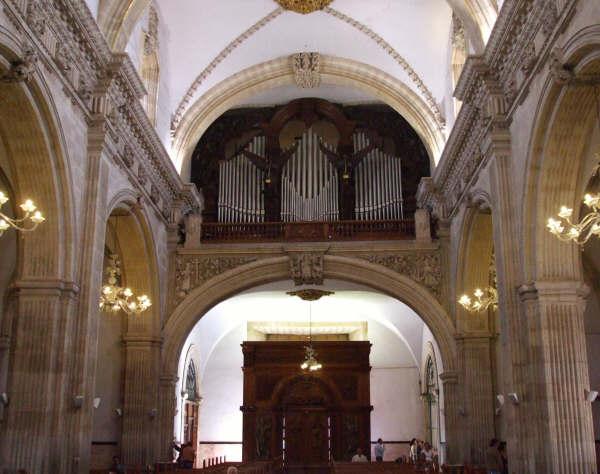
The façade was designed by a priest of the diocese and was built by a local carpentry firm, the quality of the carving is quite good. The balance of the organ "case" is a free standing brick structure in the choir gallery. According to the Cathedral organist, Jose Farfan, whose Uncle was Cathedral organist before him, the Hook organ suffered extensive termite damage and was completely discarded in 1955.
Database Manager on June 22nd, 2008:
Updated through on-line information from Richard E Mc Candlish. -- I don't believe that the instrument is used for masses, as there is an electronic in the chancel, and that was what was played the last time I heard mass there, in May, 2008. The last time I examined the Walcker was over 20 years ago, and it was barely playable at that time. With little or no funds for upkeep, well....
Database Manager on October 30th, 2004:
Status Note: There 1964
Database Manager on October 30th, 2004:
In Jardine case. Recent in 1964. [Previously had 1837 Jardine, 1869 Jardine, 1885 Hook & Hastings (2-18) Op. 1244.]
Related Instrument Entries: Hook & Hastings (Opus 1244, 1885)
Something missing or not quite correct?Add NoteorAdd WebpageorAdd Cross ReferenceorSuggest an Edit