The Rudolph Wurlitzer Co.
1919
Oregon Theatre
Hubbard Building
482 State St.
Salem, OR, US
12 Ranks
Something not quite correct?Suggest an Edit
IMAGES
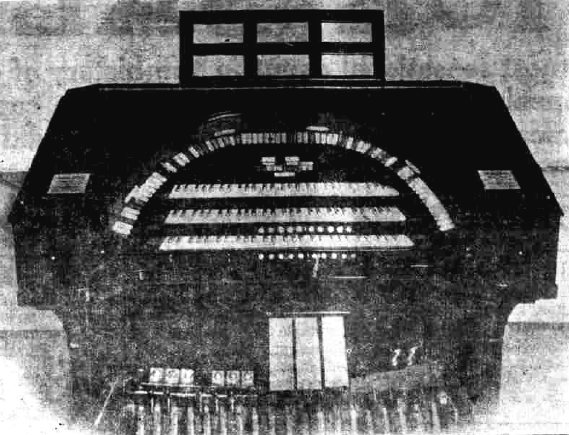
Something missing or not quite correct?Add ImageorSuggest an Edit
STOPLISTS
Something missing or not quite correct?Add Stoplist
CONSOLES
Builder: Unknown
Position: Unknown
Design: Unknown
Pedalboard Type: Unknown
Features:
3 Manuals (61 Notes)32 Note Pedal3 DivisionsElectrical Key ActionElectrical Stop ActionCombination Thumb Piston(s)Stop Layout: Unknown
Expression Type: Unknown
Combination Action: Unknown
Control System: Unknown or N/A
Something missing or not quite correct?Add ConsoleorSuggest an Edit
DETAILS
This instrument is: Not Extant and Not Playable in this location
Updated by Eric Schmiedeberg, naming this as the source of information: Tom B\'hend--Seattle--Cradle of the American Theatre Pipe Organ--CONSOLE Magazine--Vol. 3, #9--September, 1965.
It should be noted that the description of the Oregon Wurlitzer going to Seattle as a 3/6 refers to the combination of the physical structure of the console and the organ as it was at the time of its move. As mentioned before, the Echo manual was non-functional as that division had been removed from the organ in 1925. Nye actually describes the organ as a 2/6 which is, from an organ builder\'s viewpoint, entirely correct. However, this would imply that that the console was a two-manual type. That would be incorrect.
Database Manager on February 10th, 2019:
Updated by Eric Schmiedeberg, who gave this as the source of the information: Newspaper accounts, Wurlitzer Installation List by Judd Walton and photographic evidence.
Database Manager on January 26th, 2019:
Updated by Eric Schmiedeberg, naming this as the source of information: Gene Nye--Balcom and Vaughan--\"Seattle Summary\" article--Console Magazine-September \'65.
The list of organs compiled by Eugene Nye of Balcom and Vaughan Organ Co. shows that in 1935 the 3/12 Oregon Theatre Wurlitzer went to Trinity Lutheran Church in Seattle as a 3/6. This confirms my suspicion that only the Echo and Solo chamber contents at the Oregon were sent back to Wurlitzer for incorporation into Opus 1257, which would be installed at the Elsinore Theatre in 1926.
Database Manager on January 4th, 2019:
Updated by Eric Schmiedeberg, naming this as the source of information: David Junchen, The Wurlitzer Organ--An Illustrated History--2005.
This instrument was the largest theatre pipe organ shipped by Wurlitzer in the year 1919, according to David Junchen\'s Wurlitzer book.
Database Manager on July 10th, 2018:
Information from The Wurlitzer Pipe Organ – An Illustrated History by David L. Junchen (comp. & ed. Jeff Weiler). The American Theatre Organ Society, 2005.
Wurlitzer Style 185 Sp - with Tibia Clausa, Kinura, and 3-rank Echo
Factory date: September 17, 1919
Database Manager on November 7th, 2015:
Updated through online information from Eric Schmiedeberg. -- The timeline for this instrument is November 1919 to March 1929.
Database Manager on October 26th, 2015:
Updated through online information from Eric Schmiedeberg. -- This instrument replaced Wurlitzer Opus 203--a 2/4 Style 135 with Piano console. This is the third and final organ to be shipped to the Oregon. Before Opus 203 there was a 2/9 Austin of 14 registers which served from January 1913 to March 1919.
The 3/12 was played by numerous "name" theatre organists including L. Carlos Meier and Homer C. MacDonald and was known as "one of the sweetest organs in the Pacific Northwest", according to newspaper accounts. Owner George Guthrie brought new organists to the Oregon about every 3 months, so the Oregon's organist "autograph book" reads like a "who's who" of artists.
The organ debuted November 4, 1919 with Margaret Faber, organist from the People's Theatre in Portland (a Style 4 2/8 Wurlitzer). This Wurlitzer was very much a "show organ" being installed in a theatre that sat only approximately 750. The "footprint" of the Oregon survives today and it is clear just how small the auditorium was.
The Echo chamber was in the center of the ceiling directly over the audience. The sound must have been all-enveloping with this chamber's pipework in play. A Grand Piano placed onstage would be added by B.C DaShiell of Seattle in 1923. This took seven weeks to complete, according to newspaper accounts. Grand Pianos on theatre organs of any make were (and are) very rare in the U.S.
Another rare feature of the 3/12 was the Echo Chamber. Wurlitzers of under 32 ranks rarely featured these. This Wurlitzer also featured a true Echo division in that the Echo Chamber was played from its own keyboard which could be coupled to any other manual and the Pedal.
Some time in 1925 the Solo and Echo Chambers were dismantled and sent back to Wurlitzer for incorporation into Opus 1257, a 3/13 Style 235 Special which would debut at Guthrie's newest theatre, the Elsinore.
Photographic evidence shows that the Oregon Kinura/Tibia/Tuba manual chest from the Solo and Vox/String/Flute manual chest from the Echo ended up in 1257. The Kinura and 10" scale Tibia were traded back in along with one of the 25-note Cathedral Chime sets Solo or Echo?). The Echo's Flute was re-used in 1257 (the pipes were stamped "Echo") as was (most likely) the Echo's Vox Humana.
It is my theory that the Oregon's Echo string rank was a 60-scale Gamba. Gambas are one of the rarer ranks found on Wurlitzers and occupies the chest that would normally hold a Salicional in a 235. The Gamba is such an odd-ball rank in a 235, I think it "came along for the ride" to the Elsinore with its Oregon compatriots.
A vintage photo of the Elsinore's Main manual chest clearly shows the Gamba being somewhat larger than the 64-scale Violins sitting near it and being in the Salicional position. The Echo's Harp most likely found it's way to 1257 as well. I owned the Elsinore's Percussion Chamber shutter set for a time and saw the original 1926 Elsinore Main and Solo shutter sets. The shutters I had were clearly of earlier vintage structurally. I am convinced this was the Oregon's Echo shutter set.
Guthrie funded the building of the Elsinore himself and ran over-budget. This likely explains why the recycled parts from the Oregon were used. From some time in 1925 until March of 1929 the Oregon probably continued on with a 6 rank organ consisting of 8' Vox, 8' Clarinet, 16'Flute, 8' Violin, 8' Violin Celeste and 16' Open Diapason (low 12--Diaphonic) with a Chrysoglott all in the house-left chamber (Main) and a Grand Piano on stage (!). Of course the Echo manual would be useless--so a 2/6. This instrument went to Seattle in 1935 according to the PSTOS.org website.
Database Manager on November 10th, 2007:
Identified through online information from James R. Stettner. -- Organ shipped from factory in Sept. of 1919. It was a style 185 "Special." In 1925, it was returned to the Wurlitzer factory where it was rebuilt and enlarged to be a 3/13 instrument. Redesignated as opus 1257, it was installed in Salem's Elsinore Theatre in 1926.
Something missing or not quite correct?Add NoteorAdd WebpageorAdd Cross ReferenceorSuggest an Edit