Aeolian-Skinner Organ Co.
Opus 1009, 1940
Originally Ernest M. Skinner Company (Opus 175, 1909)
Cornell University
Sage Chapel
548 College Avenue
Ithaca, NY, US
68 Ranks - 4,013 Pipes
Something not quite correct?Suggest an Edit
This instrument has multiple revisions:
IMAGES


Something missing or not quite correct?Add ImageorSuggest an Edit
STOPLISTS
| Great (II) | ||
| 16' | Quintaten | 61 |
| 8' | Principal | 61 |
| 8' | Bourdon | 61 |
| 8' | Spitzflote | 61 |
| 4' | Principal | 61 |
| 4' | Rohrflote | 61 |
| 2 2⁄3' | Quint | 61 |
| 2' | Super Octave | 61 |
| IV | Full Mixture | 244 |
| IV | Fourniture | 244 |
| III | Cymbel | 183 |
| 8' | Trumpet | 61 |
| Swell to Great | ||
| Choir to Great | ||
| Positiv to Great | ||
| 4' | Swell to Great | |
| 16' | Swell to Great | |
| 4' | Great to Great | |
| 16' | Great to Great | |
| Great Unison Off | ||
| 4' | Choir to Great | |
| 16' | Choir to Great | |
| 16' | Positiv to Great |
| Swell (III - Expressive) | ||
| 16' | Bourdon | 73 |
| 8' | Diapason | 73 |
| 8' | Stopped Diapason | 73 |
| 8' | Viole de Gambe | 73 |
| 8' | Viole Celeste | 73 |
| 8' | Aeoline | 73 |
| 4' | Principal | 73 |
| 4' | Cor de Nuit | 73 |
| 2' | Fifteenth | 61 |
| III | Plein Jeu | 183 |
| 16' | Fagotto | 73 |
| 8' | Trompette | 73 |
| 8' | Oboe | 73 |
| 8' | Vox Humana | 73 |
| 4' | Clarion | 73 |
| Tremolo | ||
| Choir to Swell | ||
| 4' | Swell to Swell | |
| 16' | Swell to Swell | |
| Swell Unison Off |
| Choir (I - Expressive) | ||
| 8' | Viole | 73 |
| 8' | Concert Flute | 73 |
| 8' | Erzahler | 73 |
| 8' | Erzahler Celeste | 61 |
| 4' | Flauto Traverso | 73 |
| 2' | Zauberflote | 61 |
| 8' | English Horn | 73 |
| 8' | Cromorne | 73 |
| Tremolo | ||
| Swell to Choir | ||
| Great to Choir | ||
| 4' | Swell to Choir | |
| 16' | Swell to Choir | |
| 4' | Choir to Choir | |
| 16' | Choir to Choir | |
| Choir Unison Off | ||
| Choir Manual I alone |
| Positiv (I) | ||
| 8' | Nason Flute | 61 |
| 4' | Nachthorn | 61 |
| 2 2⁄3' | Nasat | 61 |
| 2' | Italian Principal | 61 |
| 1 3⁄5' | Terz | 61 |
| 1' | Oktav | 61 |
| III | Zimbel | 183 |
| Positiv Manual I alone |
| Pedal | ||
| 32' | Contra Bourdon | 7 Bourdon |
| 16' | Principal | 32 |
| 16' | Violone | 32 |
| 16' | Bourdon | 32 |
| 16' | Echo Lieblich | SW |
| 8' | Principal | 32 |
| 8' | Gedackt Pommer | 32 |
| 8' | Violone | 12 Violone |
| 5 1⁄3' | Quint | 32 |
| 4' | Principal | 32 |
| 4' | Koppelflote | 32 |
| 2' | Blockflote | 32 |
| IV | Fourniture | 128 |
| 16' | Bombarde | 32 |
| 8' | Trompette | 12 Bombarde |
| 4' | Clarion | 12 Bombarde |
| Swell to Pedal | ||
| Great to Pedal | ||
| Choir to Pedal | ||
| Positiv to Pedal | ||
| 4' | Great to Pedal | |
| 4' | Swell to Pedal | |
| 4' | Choir to Pedal |
Contract signed May 31, 1940 for $16,500. All old pipes to be repaired and revoiced. A spare knob or tablet to be provided for a Chimes control. Tin=90% block tin and 10% refined lead. Spotted Metal=45% block tin and 55% refined lead. Basses below 4'C of heavy selected Zinc with Spotted Metal mouths. COMBINATIONS: Adjustable at the console and visibly operating the draw stop knobs (remote control no-impulse action). Great - 1-2-3-4-5-6-7-8-9-0, Pedal to Manual On and Off Swell - 1-2-3-4-5-6-7-8-9-0, Pedal to Manual On and Off Choir-Positiv - 1-2-3-4-5-6-7-8-9-0, Pedal to Manual On and Off Pedal - 1-2-3-4-5-6-7-8, duplicated by toe studs General - 1-2-3-4-5-6-7-8-9-0, duplicated by toe studs REVERSIBLES: 16' stops Off, 16' couplers Off, Reeds Off, Mixtures Off, Swell to Pedal - duplicated by toe stud, Great to Pedal - duplicated by toe stud, Swell to Great - duplicated by toe stud, Choir to Pedal, Positiv to Pedal, Choir to Great, Positiv to Great, Swell to Choir. MECHANICALS: Swell Expression, Choir Expression, Crescendo with dial indicator, Sforzando. The instrument is installed in an extension of the west end of Sage Chapel. The organ was finished from guidelines set by G. Donald Harrison himself in the chapel. The facade incorporates part of the Pedal Violone 16' and is from the 1898 King organ, and it is probable that the Choir Flutes 8' and 4' are King as well. There are no pipes remaining from the 1875 Hook and Hastings.
Open In New TabSomething missing or not quite correct?Add StoplistorSuggest an Edit
CONSOLES
Builder: Aeolian-Skinner Organ Co.
Position: Console in Fixed Position, Center
Design: Traditional With Roll Top
Pedalboard Type: Unknown
Features:
3 Manuals (61 Notes)32 Note Pedal53 Stops58 RegistersElectrical Key ActionElectrical Stop ActionCombination Thumb Piston(s)Combination Toe Piston(s)Coupler Thumb Piston(s)Coupler Toe Piston(s)Sforzando Thumb Piston(s)Sforzando Toe Piston(s)Stop Layout: Drawknobs in Vertical Rows on Angled Jambs
Expression Type: Balanced Expression Shoes/Pedals (Meeting AGO Standards)
Combination Action: Adjustable Combination Pistons
Control System: Unknown or N/A
Something missing or not quite correct?Add ConsoleorSuggest an Edit
DETAILS
Exhibited in the 1980,2018 OHS convention(s)
This instrument is: Extant and Playable in this location
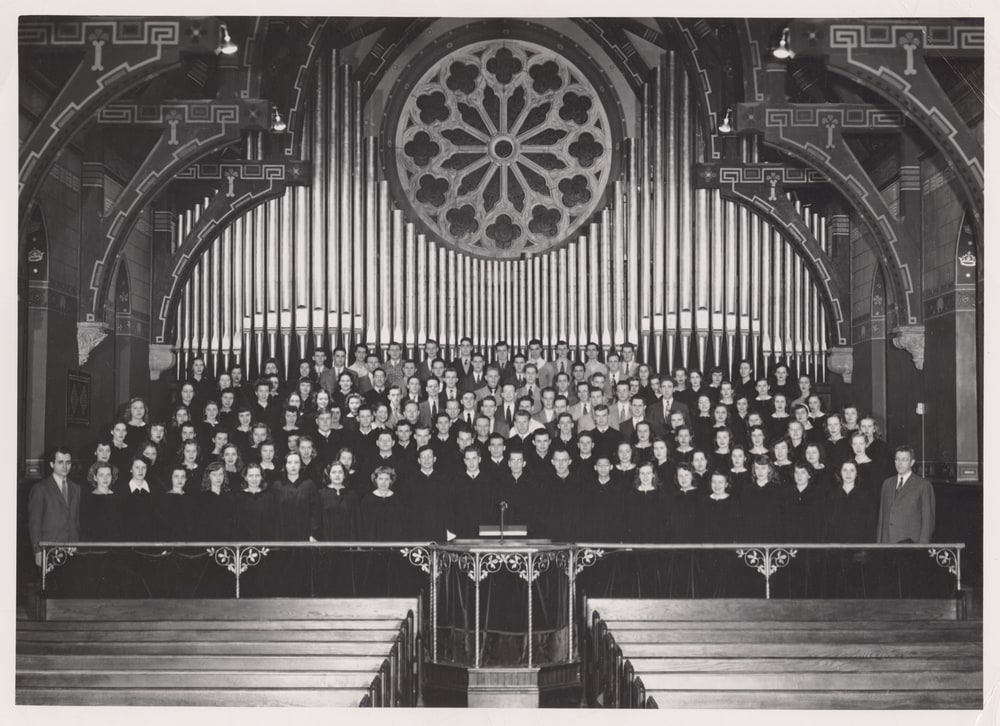
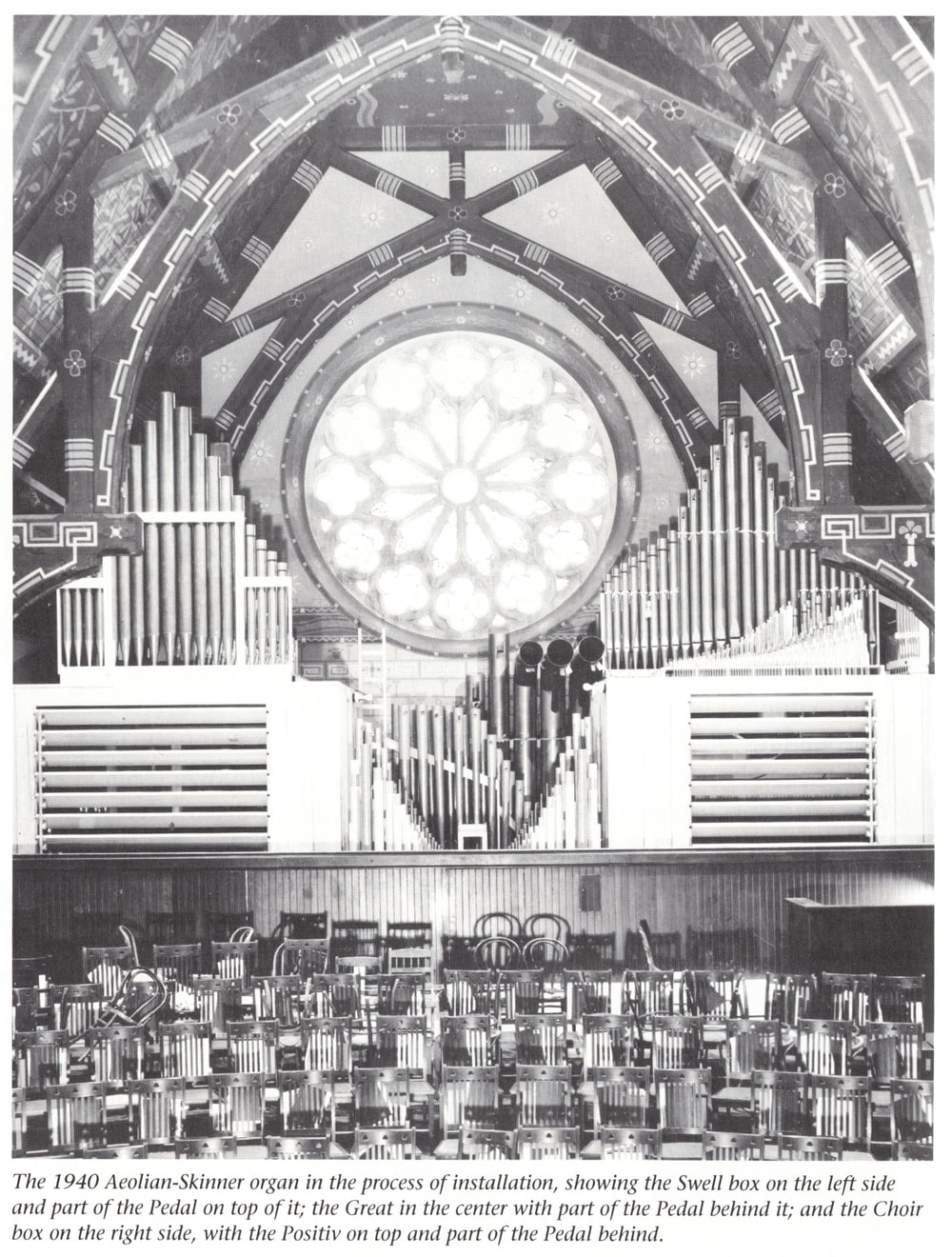
Due to the squat architectural proportions of the chapel, the organ is erected on the chapel floor. The choir risers extend a considerable height in front of the instrument, so much so that the top row choristers heads are above the impost at the level of the facade mouths. (See the 1948 image.) Much of the instrument speaks at ankle level or below of these choristers. In the 1940 installation image, we see what looks like wooden wainscot filling in the space between the impost and top row riser. At some point in the organ's career, the wainscot was replaced by what look like gigantic HVAC return air grills. (See Bryan Dunnewald image of the impost area submitted by Jeff Scofield on 11/20/2011.) Looking down at an angle through this grillwork, we see some of the lower portions of the instrument. (See Bryan Dunnewald's "Great pipework" image.)
Paul R. Marchesano on August 27th, 2021:
Exhibited in the 1980 OHS Convention
Database Manager on November 22nd, 2011:
Updated through online information from Bryan Dunnewald.
Database Manager on May 7th, 2007:
Updated through information adapted from E. M. Skinner/Aeolian-Skinner Opus List, by Sand Lawn and Allen Kinzey (Organ Historical Society, 1997), and included here through the kind permission of Sand Lawn:
Replaced #175; dedication recitals played by Richard Gore on December 8, 1940 and Luther Noss on December 13, 1940; slight alterations by G.F.Adams and A.R.Strauss in 1967 with original pipework stored; combination action replaced by solid-state. [OHS Plaque!
Database Manager on October 30th, 2004:
Status Note: There 1997
Database Manager on October 30th, 2004:
Incorporates pipework from 1909 E. M. Skinner Op. 175.
Webpage Links: Opus 1009: Cornell University, Sage Chapel
Related Instrument Entries: Ernest M. Skinner Company (Opus 175, 1909) , Wm. King (& Son) (1898)
Something missing or not quite correct?Add NoteorAdd WebpageorAdd Cross ReferenceorSuggest an Edit