C. B. Fisk, Inc.
Opus 112, 1998
St. James Episcopal Church
Sanctuary
1201 West Franklin Street
Richmond, VA, US
62 Ranks - 3,439 Pipes - 4 Physical Divisions
EXPLORE IMAGESVIEW STOPLISTSomething not quite correct?Suggest an Edit
IMAGES
Something missing or not quite correct?Add ImageorSuggest an Edit
STOPLISTS
| Great (I) | ||
| 16' | Prestant | 61 |
| 8' | Octave | 61 |
| 8' | Violoncelle | 61 |
| 8' | Spillpfeife | 61 |
| 8' | Flûte harmonique | 32 ext. SF |
| 4' | Octave | 61 |
| 4' | Flute | 61 |
| 2 2⁄3' | Quinte | 61 |
| 2' | Doublette | 61 |
| 1 3⁄5' | Tierce | 61 |
| IV-VI | Mixture | 294 |
| V | Cornet (mounted) | 175 |
| 16' | Bombarde | 61 |
| 8' | Trompette | 61 |
| 8' | Trommeten | 61 |
| 4' | Clairon | 61 |
| 8' | Positive to Great | |
| 8' | Swell to Great | |
| Octaves graves |
| Positive (II - Expressive) | ||
| 16' | Violone | 61 |
| 8' | Principal | 61 |
| 8' | Salicional | 61 |
| 8' | Unda maris (tc) | 49 |
| 8' | Bourdon | 61 |
| 4' | Octave | 61 |
| 4' | Rohrflöte | 61 |
| 2 2⁄3' | Nasard | 61 |
| 2' | Doublette | 61 |
| 2' | Quarte de Nasard | PF |
| 1 3⁄5' | Tierce | 61 |
| IV | Mixture | 237 |
| 16' | Cor Anglais | 61 |
| 8' | Basson | 61 |
| 8' | Cromorne | 61 |
| Clochettes | 4 bells | |
| 8' | Swell to Positive |
| Swell (III - Expressive) | ||
| 16' | Bourdon | 61 |
| 8' | Viole de gambe | 61 |
| 8' | Viole céleste | 49 |
| 8' | Flûte traversière 8ʹ | 61 |
| 8' | Cor de Nuit | PF |
| 4' | Prestant | 61 |
| 4' | Flûte octaviante | 61 |
| 2' | Octavin | 61 |
| IV | Plein jeu | 244 |
| 16' | Basson | 61 |
| 8' | Trompette | 61 |
| 8' | Hautbois | 61 |
| 8' | Voix humaine | 61 |
| 4' | Clairon | 61 |
| Pedal | ||
| 32' | Bourdon | 12 ext. |
| 16' | Contrebasse | 32 |
| 16' | Prestant | GT |
| 16' | Violone | POS |
| 16' | Bourdon | SW |
| 10 2⁄3' | Quinte | |
| 8' | Octave | 32 |
| 8' | Violoncelle | GT |
| 8' | Spillpfeife | GT |
| 4' | Superoctave | 32 |
| IV | Mixture | PF |
| 32' | Contre Bombarde | 12 ext. |
| 16' | Bombarde | GT |
| 16' | Posaune | 32 |
| 8' | Trompette | GT |
| 8' | Trommeten | GT |
| 4' | Clairon | GT |
| 8' | Great to Pedal | |
| 8' | Positive to Pedal | |
| 4' | Positive to Pedal | |
| 8' | Swell to Pedal |
| Other | ||
| Machine On (Servopneumatic Lever) | ||
| Great Ventil | ||
| Flexible Wind | ||
| 2 Tremulants (fast & slow) | ||
| Balanced Swell and Positive Pedals | ||
| Crescendo Pedal | ||
| Pedal Reversibles | ||
| Temperament: Fisk 2 (1995) | ||
| Wind Pressures: 3-3/8" and 5" | ||
| 512 levels of memory & sequencer |
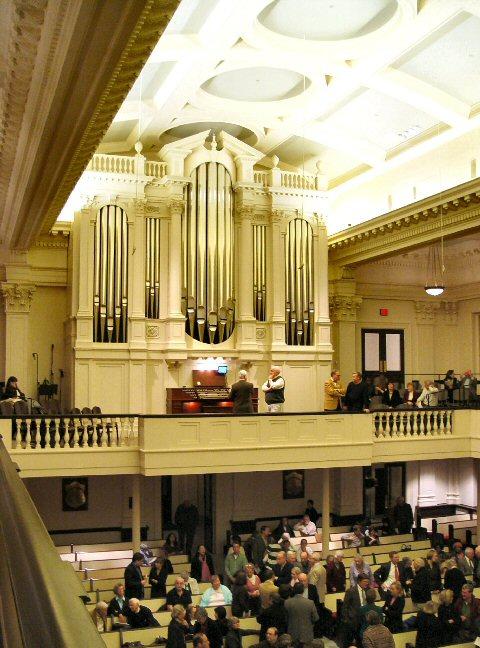
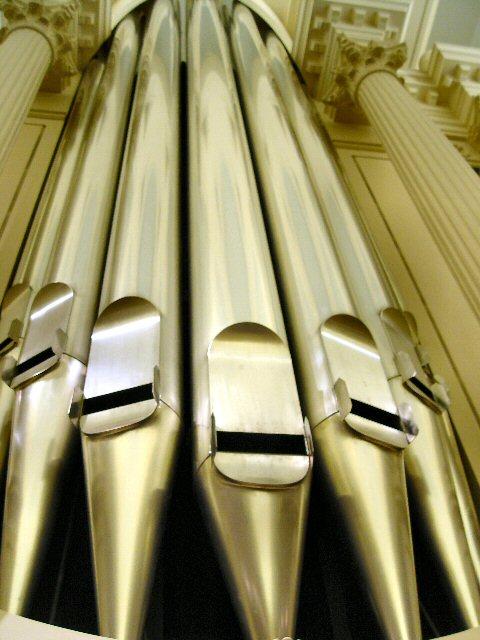
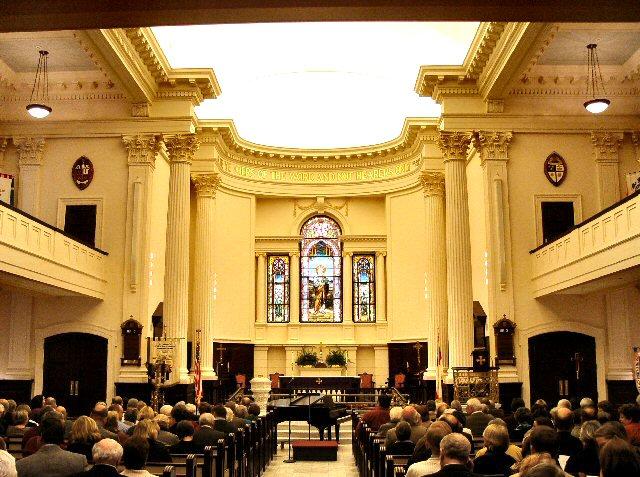
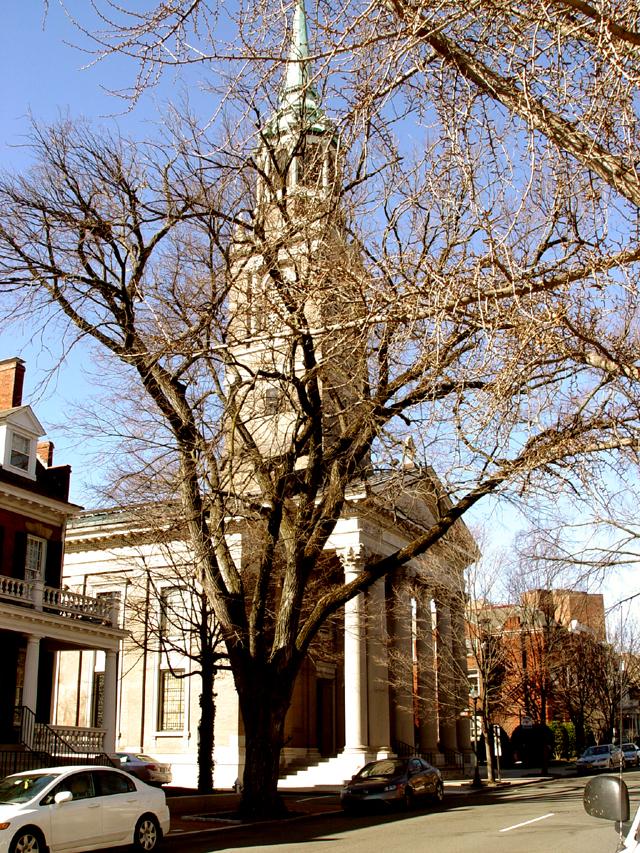
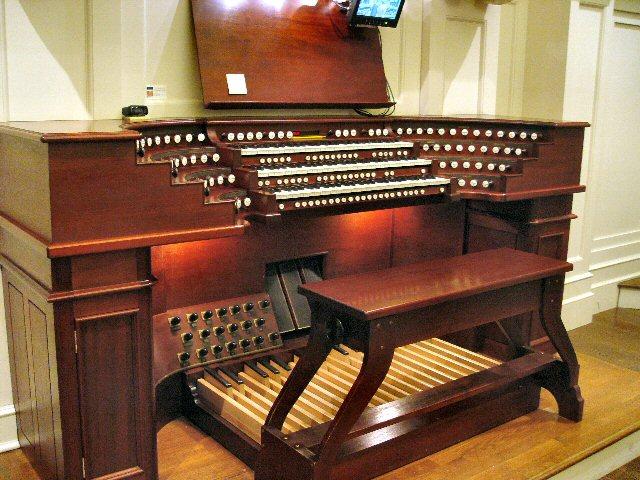
From C. B. Fisk, Inc. for the 1999 dedication program: “In the wake of a devastating fire following a lightning strike in 1994, St. James’s embarked upon a careful reconstruction of their 1839 building. C. B. Fisk, Inc. was fortunate to be included in early design discussions with architects Fred Cox and Sarah Grier and with acoustician David Klepper. It was indeed a privilege to work in a room with the distinguished beauty of the restored St. James’s. The extra height of the new barrel-vaulted ceiling and the creation of additional space in the tower made room for the largest pipes, while leaving ample space for choir in the balcony. The three manual, sixty-two stop (49 ranks) instrument is housed in an elegant painted Greek Revival case designed by Charles Nazarian. Situated in the rear gallery of the church, it stands twenty-eight feet high, twenty-five feet wide, and contains 3,439 pipes. The mahogany console, en amphithéâtre, is based on the best examples of 19th century French builder Aristide Cavaillé- Coll and places the complete resources of the instrument easily within arm’s reach. The electric stop action includes an SSOS combination action with 512 levels of memory, the SSOS Total Recall backup via USB, and a sequencer. The specification reflects the many roles a modern American church organ must play: leading congregational song, accompanying choral music, and playing over four hundred years of organ repertoire. The tonal design evolved in consultation with Dr. Robert Anderson (SMU), and the resulting eclectic stoplist is a unique, historically informed blending of stops representing many of the great eras and schools of organ building in Germany, France, England, and America. If there is a strong nod in the direction of Cavaillé-Coll, it is because in his work one finds the diversity, integrity, and expressiveness of tone most becoming to the liturgy of the Episcopal Church. Olivier Latry, organist titulaire of the Cathedral of Notre Dame, Paris, France, played two dedication concerts on Opus 112 on 18 and 19 April 1999.” Additional funding was provided by Dr. John B. Herrington for various reeds and the en amphithéâtre style console to expand the tonal resources of the instrument. The wind pressures are 85 mm (3-3/8”) for the manuals and 127 mm (5”) for the large Pedal stops supplied by a 3-H.P. 3-phase Laukhuff blower. The manual divisions are fed by a single wedge bellows and the Pedal by a parallel-rise reservoir. The temperament is Fisk 2 (1995). The Positive and Swell divisions both have expression shades on 3 sides and are located at impost level with the pipework arranged in a chromatic layout with the basses at the back of the expression box. The proximity of both expression boxes to the choir and balcony allows for greater ease in accompanying the choirs and instrumentalists. The Great division is located at the upper level of the instrument spanning the width of the organ case. Pedal basses are located to the sides and back of the organ chamber. The control system is by Solid State Organ Systems with an M3 MultiLevel Capture System (with Total Recall) with 512 memory levels and includes a USB flash drive option. A new MoBo processor with flash memory was installed in 2020. Pipe construction and voicing notes: Tonal-finishing began after Easter in April 1998 after the instrument was mechanically installed and continued until November 1998. The time spent tonal-finishing at St. James’s was about 2,500 hours (2 people with revolving teams). The team of finish-voicers was David Pike, Casey Dunaway, Stephen Kowalyshyn, Michael Kraft, and Stephen Malionek. (same staff as the previous 12 years). All stop knob names reflect an accurate description of the pipes’ construction and heritage. The Great Principal Chorus is constructed of hammered Tin in the style of Gottfried Silbermann and is voiced with generous cut-ups, moderate windways and light nicking. The Positive Chorus is constructed of hammered spotted metal (½ lead, ½ tin). There is no slotting in any of the Principal work as one would find in Cavaille-Coll’s work, only in the strings and basses of the large Pedal stops. Also of note is a plaque in the stairwell outside of the organ gallery that states that the "Trompettes, Bombardes and other reed on this organ are given in honor of Dr. Robert Anderson (of SMU) by his student Dr. John B. Herrington III". Dr. Herrington, a known benefactor of the organ world and a top-notch organist/improviser himself, is a retired pathologist in Richmond and is the major donor of this instrument.
Open In New TabSomething missing or not quite correct?Add StoplistorSuggest an Edit
CONSOLES
Builder: C. B. Fisk, Inc.
Position: Keydesk Attached
Design: Horseshoe
Pedalboard Type: Flat Radiating
Features:
3 Manuals (61 Notes)32 Note Pedal4 Divisions58 Stops61 RegistersMechanical (Suspended Tracker) Key ActionElectrical Stop ActionCrescendoSequencerCombination Thumb Piston(s)Combination Toe Piston(s)Coupler Thumb Piston(s)Coupler Toe Piston(s)Sforzando Thumb Piston(s)Sforzando Toe Piston(s)Stop Layout: Drawknobs in Horizontal Rows on Curved Jambs
Expression Type: Balanced Expression Shoes/Pedals (Meeting AGO Standards)
Combination Action: Adjustable Combination Pistons
Control System: SSO M3
Something missing or not quite correct?Add ConsoleorSuggest an Edit
DETAILS
This instrument is: ExtantandPlayable in this location
A plaque in the stairwell outside of the organ gallery states that the "Trompettes, Bombardes and other reed on this organ are given in honor of Dr. Robert Anderson (of SMU) by his student Dr. John B. Herrington III." Dr. Herrington, a known benefactor of the organ world and a top-notch organist/improviser himself, is a pathologist practicing in Richmond and is the major donor of this instrument.
Database Manager on April 20th, 2018:
Olivier Latry, organist titulare of the Cathedral of Notre Dame, Paris, France, dedicated Opus 112 on 18 April 1999.
Database Manager on June 13th, 2017:
Updated by Bruce Stevens, who has heard or played the organ.
Database Manager on October 30th, 2004:
Status Note: There 1998
Something missing or not quite correct?Add NoteorAdd WebpageorAdd Cross ReferenceorSuggest an Edit