Estey Organ Co.
Opus 1241, 1914
The Modern Theatre, Inc.
525 Washington Street
Boston, MA, US
33 Ranks
EXPLORE IMAGESVIEW STOPLISTSomething not quite correct?Suggest an Edit
🤝 Instrument entries in Massachusetts sponsored by:
We are grateful for the generous support of our sponsors, who make it possible for us to continue our mission of preserving and promoting the rich history of pipe organs across the globe.

IMAGES
Something missing or not quite correct?Add ImageorSuggest an Edit
STOPLISTS
Something missing or not quite correct?Add Stoplist
CONSOLES
Builder: Unknown
Position: Console in Fixed Position, Center
Design: Unknown
Pedalboard Type: Unknown
Features:
3 Manuals (61 Notes)32 Note Pedal4 Divisions31 Stops42 RegistersElectrical Key ActionElectrical Stop ActionStop Layout: Unknown
Expression Type: Unknown
Combination Action: Unknown
Control System: Unknown or N/A
Something missing or not quite correct?Add ConsoleorSuggest an Edit
DETAILS
This instrument is: ExtantandPlayable in this location
Rebuilt by Estey in 1926 as Op. 2528.
Jeff Scofield on August 31st, 2023:
From Wikipedia: In 1876, Boston architect Levi Newcomb designed a warehouse and showroom for John and James Dobson, owners of the largest carpet mills in the United States. The five-story High Victorian Gothic building was constructed of Ohio sandstone with cast-iron store-fronts on the ground floor. The Dobsons relocated from the Blackstone National Bank building in early 1878.
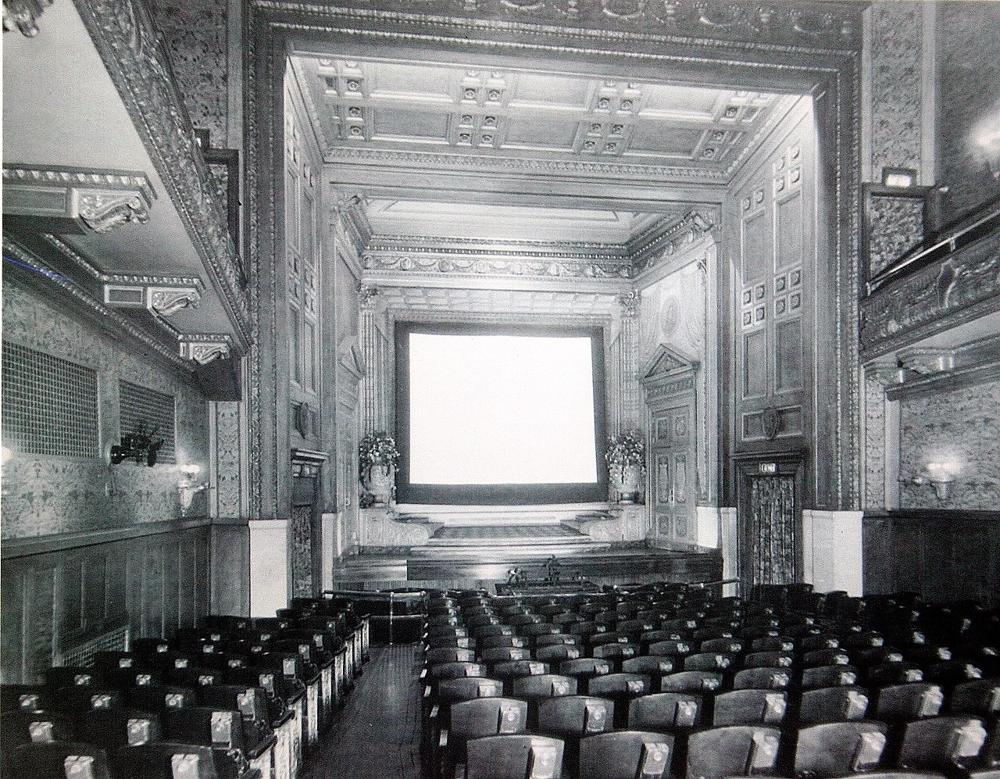
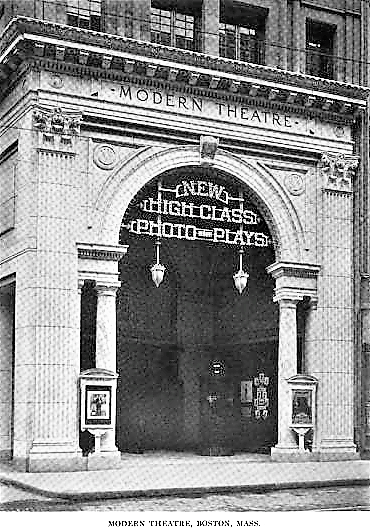
Boston businessman George White hired Clarence H. Blackall in 1913 to convert the basement and first two floors into a theater for the newly popular photo-plays. The architect's plan for the first floor shows a vestibule with a circular ticket office and a small lobby opening onto a long, narrow auditorium with a balcony, seating about 800 in total. There was a small stage, with an adjoining dressing room, and an orchestra pit, which contained an Estey organ with three manuals and thirty-three ranks of pipes. Acoustic design for the auditorium was done in consultation with Wallace C. Sabine, a professor of physics at Harvard University and a pioneer in architectural acoustics. The interior decoration, described as Florentine Renaissance, used Italian marble, dark mahogany and ersatz tapestry. Blackall also added a neoclassical facade carved from white Vermont marble. The theater was air-conditioned, as reported by the Boston Evening Transcript.
The Modern Theatre, believed to be the first in Boston designed specifically for movies,[note 2] was opened on June 25, 1914, by Boston theater entrepreneur Jacob Lourie, with programs of silent films, vocal music performances and organ recitals. In 1927, Lourie installed Vitaphone equipment for a showing of Don Juan. The next year the Modern programmed The Jazz Singer, the first feature-length Vitaphone movie with both music and spoken dialogue. Renamed the Mayflower Theatre in 1949, by the 1970s it was, like other theaters in the area, showing adult films. The Mayflower closed in 1976 and fell into neglect. In 1977, David L. Archer, a 28-year-old actor and producer, began to renovate the theater for use as a community performance space. The venture was short-lived, and the Modern Theater closed in May, 1981, after hosting over 200 events.
After several changes of ownership but with no progress on restoration, Suffolk University purchased the property in 2007, with plans to increase their stock of student housing. In 2009 they demolished the building after carefully removing the facade. CBT Architects of Boston designed a new state-of-the-art theater with a ten-story residence hall above it. The conserved original facade was attached to the new building. Suffolk's new Modern Theatre, a multi-purpose space seating 185, opened on November 4, 2010.
Database Manager on September 7th, 2007:
Identified by James R. Stettner through information from the Estey Opus List, published in The Boston Organ Club newsletter, 1973-1979.
Related Instrument Entries: Estey Organ Co. (Opus 2528, 1926)
Something missing or not quite correct?Add NoteorAdd WebpageorAdd Cross ReferenceorSuggest an Edit