The Rudolph Wurlitzer Co.
Opus 998, 1925
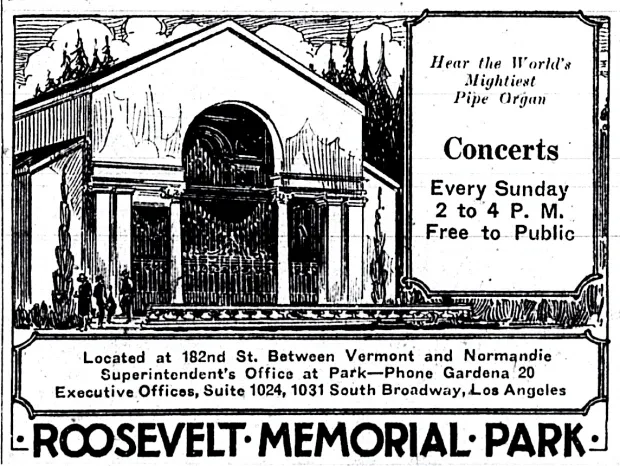
Roosevelt Memorial Park
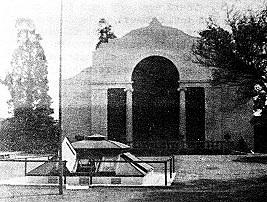
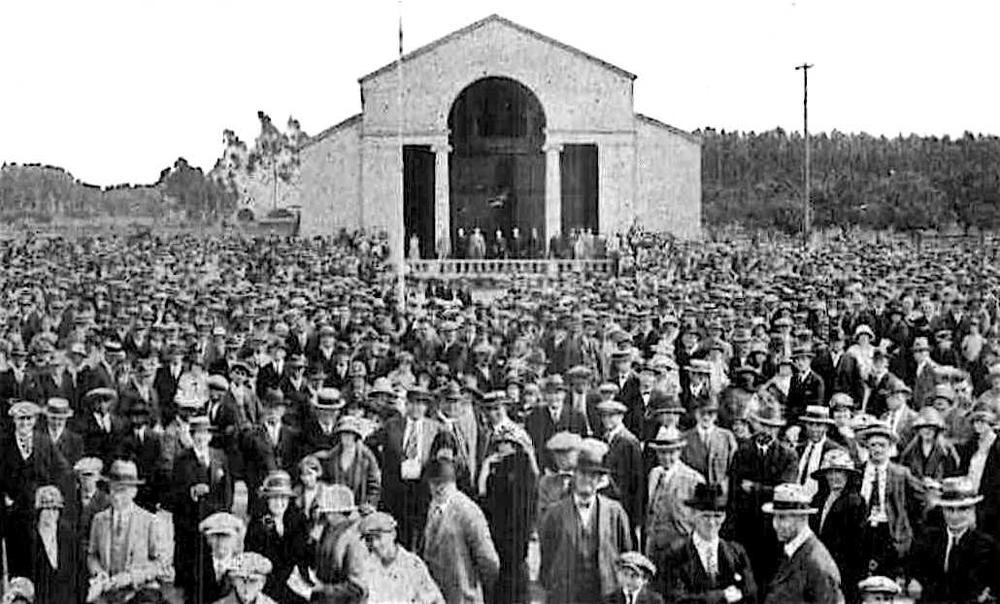
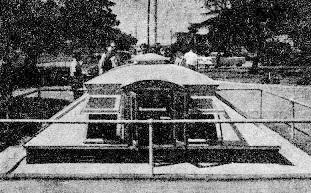
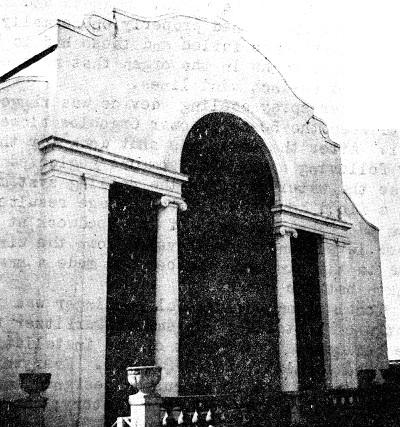
Organ Pavilion Building
18255 Vermont Ave.
Gardena, CA, US
17 Ranks
Something not quite correct?Suggest an Edit
🤝 Instrument entries in California sponsored by:
We are grateful for the generous support of our sponsors, who make it possible for us to continue our mission of preserving and promoting the rich history of pipe organs across the globe.

IMAGES
Something missing or not quite correct?Add ImageorSuggest an Edit
STOPLISTS
Something missing or not quite correct?Add Stoplist
CONSOLES
Builder: Unknown
Position: Unknown
Design: Horseshoe
Pedalboard Type: Concave Radiating (Details Unknown)
Features:
4 Manuals (61 Notes)32 Note Pedal5 Divisions139 StopsElectrical Key ActionElectrical Stop ActionCrescendoCombination Thumb Piston(s)Stop Layout: Stop Keys in Horseshoe Curves
Expression Type: Unknown
Combination Action: Setterboard
Control System: Unknown or N/A
Something missing or not quite correct?Add ConsoleorSuggest an Edit
DETAILS
This instrument is: Not Extant and Not Playable in this location
Updated by Eric Schmiedeberg, who gave this as the source of the information: I toured the organ in 1993 and got a chance to play it. I also have a friend who did tuning and maintenance work on the organ many years ago..
For a detailed description of the Wurlitzer/Hope-Jones Suitable Bass and \"Balanced Swell Pedal\" (the Hope-Jones definition of that term) system that this organ incorporates, please see organ ID 52040. PLEASE BE ADVISED THAT THE URL ABOVE CONTAINS AN INCORRECT STOPLIST FOR ROOSEVELT. The OHS Database listing is correct and expanded as edited by myself and the OHS Database. Check out the website URL given above for a nice write-up by the (now) former curator of the instrument. I have expounded upon and corrected this as well.
I have it on very good authority that, many moons ago when the organ was mostly operational, the tuning of the instrument was something of an ordeal. The sound pressure levels were so extreme when tuning the 35\" and 50\" wind pressure pipes that the tuner I know had to wrap himself with wet towels to suppress nausea caused by the intense vibration. This is no \"old wives tale\". My friend is totally credible and not given to exaggeration. The organ was a real monster when it was \"firing on all cylinders\". He confided in me by telling me that he had to run to the back of the organ building to throw up on more than one occasion. Few are alive today that did any maintenance work on the organ back in the organ\'s better days. As a result, an accurate appreciation of what the Roosevelt organ was REALLY has almost faded into obscurity. One theatre organ old-timer by the name of Joe Koons stated that the organ could be heard all the way out to Catalina Island--when the wind was right! From Gardena, that is some 38 miles! I don\'t doubt him, either.
The former curator of the Roosevelt organ was not a \"Wurlitzer Guy\", per se. There is an inaccuracy in his write-up with respect to the chest action problems at Roosevelt. Wurlitzer\'s chest actions are perfectly operational on 25\" wind. Numerous instruments were built with 25\" pressure ranks. I suspect that the 35\" level was where the trouble started to crop up.
Something else: The windtrunks were retrofitted with lead lining in addition to clamp-down turnbuckles to prevent them from flying apart. The pressure wasn\'t the only problem. Wood is a very dynamic material. The cemetery is not far from the ocean and it DOES rain in California--despite the song! Extreme heat and humidity fluctuations within and without this outdoor organ made for a LOT of movement of the metal and wooden parts of the organ. In other words, the whole organ! This was exacerbated by the \"cooling system\" that was employed to keep the air in the organ cooled. That system consisted of a water spray being injected into the intake of the blower. With the pressures involved, one can only imagine the amount of pneumatically-induced internal friction that was present in the organ. The \"floating organ and console\" incident is a myth. There might have been a \"flood\", but I saw no damage to the console in the console pit and no damage that would certainly be evident in the chambers. Logically, the water would have partially filled the blower tank and then start to spill out of the intake.
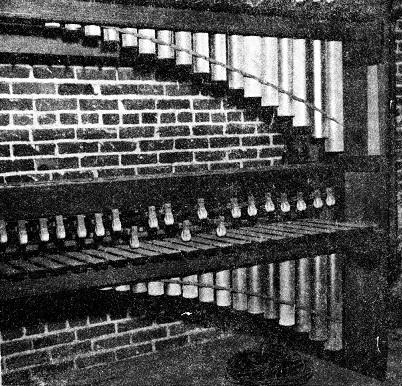
I made the hair-raising journey up the steel ladder (UNENCLOSED) to get to the attic where the low notes of the 32\' Diaphones poked their heads out of the semi-circular opening in the front of the organ pavilion. I had to see the tops of these monsters for myself. They were indeed bigger than the 32\' Diaphones that Wurlitzer put on their stock instruments. Forty-two inches square at the top? Okay. Yeah. There was also a \"Thunder Drum\" (as Wurlitzer called their large orchestral Bass Drum) up there and a battery of Snare Drums--3 that all played together....at one point in time. There was also a standard-scale Marimba/Harp and a 30-note set of fixed-scale chimes with 2\" diameter tubes. These played a little bit from the console; a pleasant sound. Extra-large-scale 32\' Diaphones speaking into the open air is akin to a giant badly in need of Beano! Enclosed environments are much kinder to these types of bass voices. I would like to add that walking around on the attic floor was somewhat hair-raising as well!
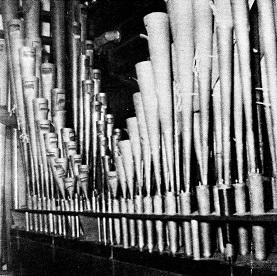
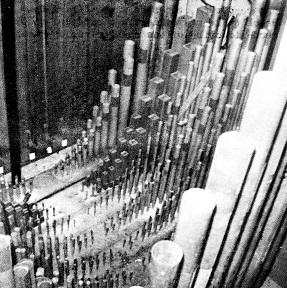
The scaling of the pipework in the organ is very large in most places. The Voxes ran on 15\", but looked fairly typical--except for the screws used to keep the reed blocks from launching out of their boots. The \"Orchestral Oboe\" was actually built like a 15\" English Post Horn--and sounded like it. All of the string voices were of small-scaled Diapason size. Really, the Main and Solo chambers didn\'t present any huge surprises. The Foundation and brass chambers were another story. The English Post Horn was scaled like a small Tuba and bottomed out as such. The Tuba Mirabilis was beefy, but not much. The Foundation was the really spectacular display. The Tibia Plena and Diaphonic Diapason were of prehistoric dimensions. Reeds can be deceiving--the power source is really in the reeds and shallots, mainly. Strings can be more revealing as to their power as related to their scale. But open, foundational flue stops? They can\'t hide. Roosevelt\'s LOOK monstrously powerful. Get out the wet towels...you will need them. That is a true story. The Brass Chamber was no fun, either.
This organ could not be played like a theatre organ. That is not the sound one was dealing with. This is a concert organ. Frankly, the Brass and Foundation chambers were really \"accent\" and \"fanfare\" types. I think the Foundation ranks were only useful in the ensemble if you had all of the Main and Solo stops drawn to support it. Also, trying to get any sense of tonal balance from the console would have been pretty much hopeless. The Main and Solo face each other and the \"exterminator\" ranks in the Foundation and Brass faced the organist head-on. The balance of the organ changed as you walked around the park near the organ pavilion building as well.
The approach one would take with this organ in playing it would be with both hands on a manual at any one time. This was reflected by the tone of the organ and the repertoire it suggested thereby and the types of couplers the organ has and how they are distributed. The Suitable Bass system present in the Roosevelt console would actually be quite useful in this two-hands-one-one-manual approach....IF the wiring of the system was right....a BIG \"if\".
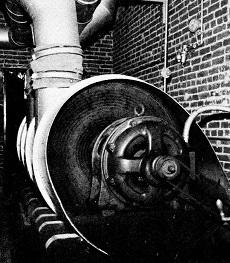
The blower tank on the organ was of Fox Special scale--huge. Eight feet long...yeah. That is about right, I think. The double-throw starter switch was a hoot to witness in operation. The stick reminds me of one you would have found on an antique car that operated the parking brake. When to shift from the 440V starting voltage to the 220V running voltage was much like a car. You listened for the pitch and speed of the motor to tell you when.
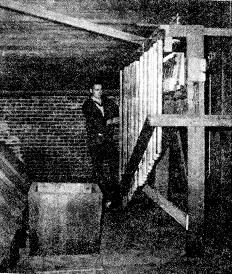
The organ was in sad shape when I visited the park in \'93. Only the pipework in the Main was responsive from the console in any way. I had to sample the pipe tones from the other chambers by pushing up on primary valve stems on the chests. That was more than enough, I assure you! E-nough! The damage from the 1933 Long Beach Quake was still evident inside and outside the organ pavilion. Sections of the ceiling plaster in the chambers had fallen to the floor...or in other, less-tolerable places. Plastic sheets were put up channel water away from organ components.
The Roosevelt Memorial Park Association has run the park since 1924. The Director there told me that once the last member of the Cemetery Association Board died, the organ really dropped off the the list of things the park really cared about. Nobody dared do anything to get rid of it until the last of the Old Guard passed away. I understand the cemetery needed a mausoleum more than a pipe organ. Someone (who will remain nameless, but knows what they\'ve got) got it out of the cemetery before disaster ensued. Where to put it, though? That\'s a challenge, do doubt about it.
The organ\'s chamber analysis in the Wurlitzer book by David Junchen is incorrect. The correct one I will include in my edits of that, and the stoplist.
Database Manager on January 10th, 2009:
Identified through information posted to OHS Members List by Laurence Libin: -- Outdoor organ; "Concert" specification. Removed to storage November, 2008 after several years of not being in playing condition.
Something missing or not quite correct?Add NoteorAdd WebpageorAdd Cross ReferenceorSuggest an Edit